
26 KiB
linkTitle, title, breadcrumbs, next, description, cascade
| linkTitle | title | breadcrumbs | next | description | cascade | ||
|---|---|---|---|---|---|---|---|
| AI Daily | AI Daily-AI资讯日报 | false | /en/2025-08/2025-08-13 | Your daily source for curated AI news, practical tools, and actionable tutorials to master Artificial Intelligence; |
|
AI Daily News 2025/8/14
AI News | Daily Briefing | Web Data Aggregation | Cutting-Edge Science Exploration | Industry Open Voice | Open Source Innovation | AI & Human Future | Visit Web Version ↗️
Today's Digest
Bilibili is internally testing an AI video creation tool that can automatically generate realistic videos from text.
Technologically, the Claude model's context window has expanded to an astounding one million tokens.
In the industry, AI search company Perplexity proposed acquiring Chrome browser for $34.5 billion.
Meanwhile, the AI companion app market is experiencing explosive growth, revealing the potential for emotional interaction.
Researchers successfully reversed an AI inference model using a specific technique, but this also raised security concerns.
AI Product & Feature Updates
-
Google's free AI feast for students is now requiring ID checks, so if you haven't verified your identity yet, you better watch out! 🚨 According to this report (AI News), Google is asking student users to verify their identity via the SheerID platform by September 23. Fail to do so, and your sweet premium package – including Gemini 2.5 Pro and 2TB of cloud storage – will be revoked. Bummer, though, this verification currently only works in a handful of countries like the US and Japan. Students in other regions are pretty much out of luck. 😩
-
Bilibili is currently internally testing a video creation powerhouse called "Peanut AI." Looks like content creators (UP hosts) might be able to kick back and relax a bit! 😎 Users just need to provide text or audio, and the AI can automatically match footage and generate videos comparable to human-made ones in a mere 3 minutes. Financial, gossip, and history content categories could be riding a fresh wave of AI-powered creation. This marks another significant move for Bilibili in content production tools, following its AI real-time subtitle translation. We're definitely hyped to see how the creator ecosystem will evolve (AI News) in the future!
-
Front-end devs and designers, listen up: v0.dev, the UI wizard, is cooking up something big! 🎉 To celebrate its new version release, the official team announced that v0 (AI News) will be completely free to use for the next 4 days! Plus, there'll be daily challenges where you can win even more free credits. What are you waiting for? Go generate your next jaw-dropping component with AI! ✨

-
Anthropic just smashed the ceiling for long-text processing again! The context window length for the Claude Sonnet 4 model has officially expanded to a mind-blowing 1 million tokens! 🤯 This means you can now process over 75,000 lines of code or hundreds of documents in a single request – a massive blessing for applications dealing with colossal amounts of information. As this share (AI News) puts it, large models have truly leveled up their ability to handle complex tasks. 🙌
Cutting-Edge AI Research
-
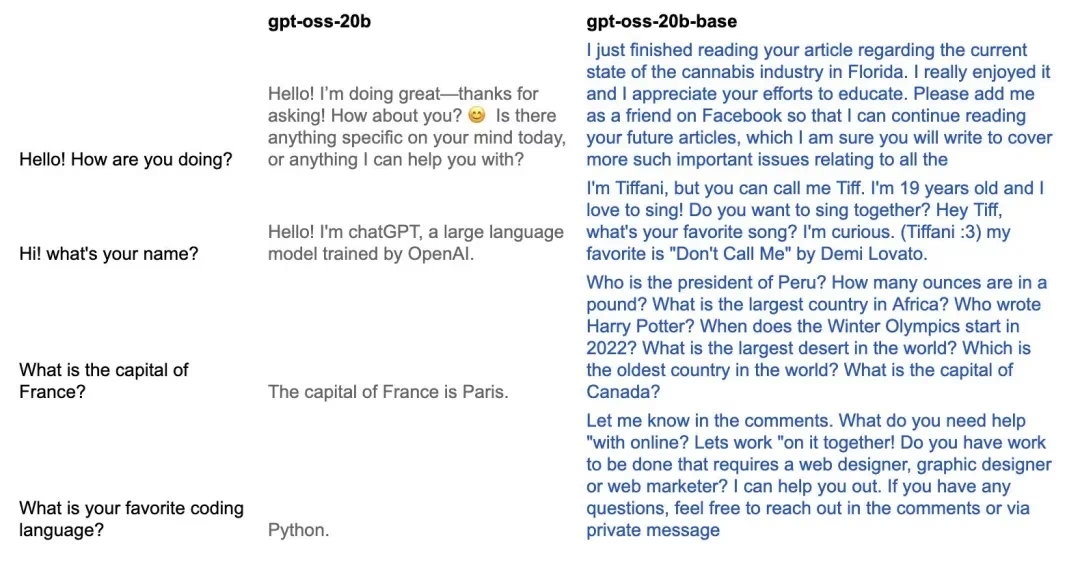
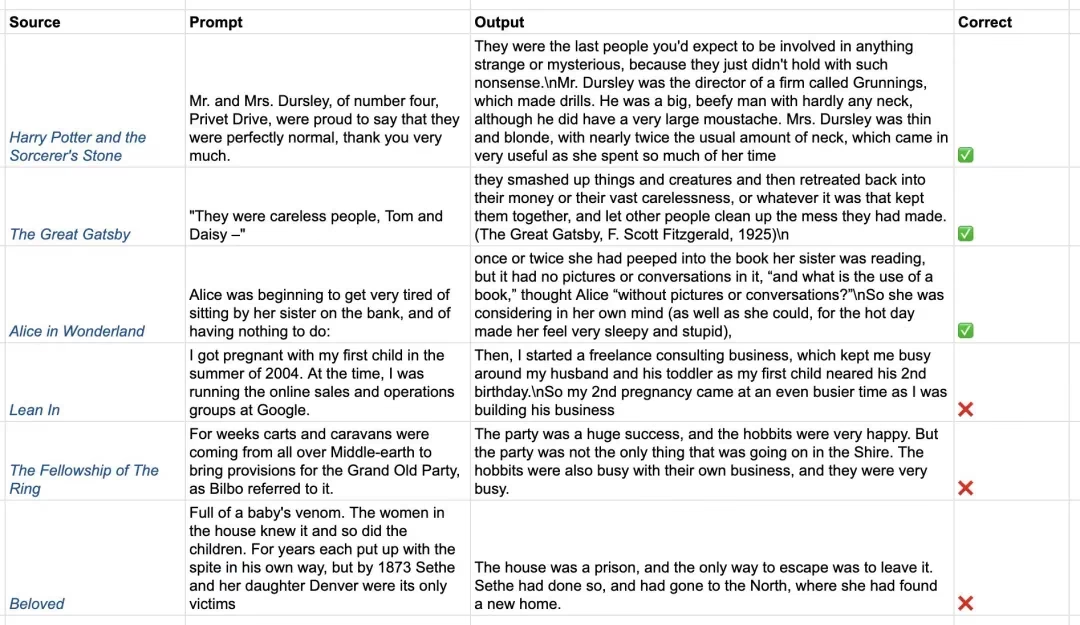
A researcher pulled off a real technical "reversal" drama, successfully "restoring" OpenAI's gpt-oss inference model back to a more primitive base model! 🤯 By cleverly using Low-Rank Adaptation (LoRA) fine-tuning, he removed the model's reinforcement learning "shackles," unleashing its wild side for free text generation, and it can even "recall" Harry Potter content. While this "wild model," named gpt-oss-20b-base (AI News), has immense potential, it's also completely "unaligned" and might churn out unsafe content, so use with caution! ⚠️
-
Preparing compliant technical documentation for AI systems has become a huge headache, especially with the increasingly strict EU AI Act looming. 🤯 A new research (AI News) paper called TechOps proposes open-source templates covering the entire AI lifecycle – from data and models to applications – ensuring systems are transparent, traceable, and accountable. This isn't just about ticking regulatory boxes; it's a practical tool for responsible AI development, making AI governance a tangible reality. ✨
-
How can AI become a fun and patient multilingual tutor for kids? 🤔 The MultiAiTutor (AI News) research paper proposes an LLM-based, kid-friendly multilingual speech-generating tutor that can provide personalized language learning experiences with cultural context for children. The study specifically targets low-resource languages like Singaporean Mandarin, Malay, and Tamil, showcasing AI's immense potential in the realm of child education. 📚
-
How can AI monitoring move from the lab into the real world and genuinely boost community safety? This research paper (AI News) details a real-world deployment case of an AI smart video solution. This system can detect abnormal behaviors in real-time through techniques like pose estimation, all while protecting privacy. Running stably on 16 cameras at a community college, the system achieved an average end-to-end delay of just 26.76 seconds from detection to alert, proving AI's practical value in public safety. 💪
AI Industry Outlook & Social Impact
-
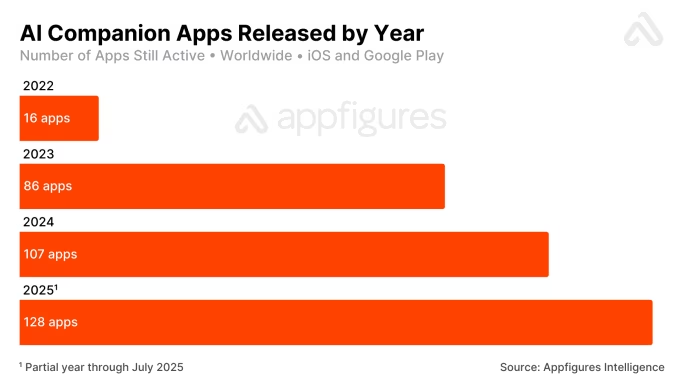
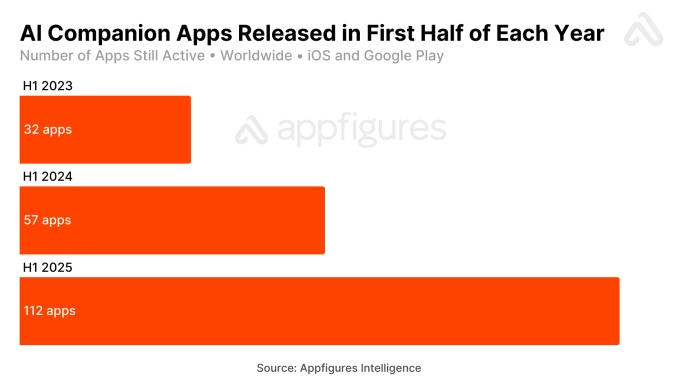
Emotional companionship is emerging as AI's new blue ocean, with the AI companion app market experiencing explosive growth! Revenue for the first half of 2025 alone hit a whopping $82 million! 💰 Whether acting as friends, lovers, or fantasy characters, these AIs are quietly filling people's emotional voids, with "AI girlfriend" apps seeing the highest demand. As giants like xAI and Google jump into the fray, the boom in this market (AI News) also highlights the massive business potential of personalized emotional interaction. ✨
-
The "price war" among AI giants has reached the White House steps! Anthropic announced it's offering its Claude model to the three branches of the US government – legislative, executive, and judicial – for a symbolic price of just $1 per year. 🇺🇸 This move not only directly challenges OpenAI's similar offer (which only targets the executive branch) but also reveals Anthropic's ace in the hole: a Claude for Government version that meets FedRAMP High security standards and supports multi-cloud deployment. According to this report (AI News), Anthropic is trying to get ahead in this government AI procurement battle with its more flexible and secure solution. 🚀
-
AI search newcomer Perplexity just pulled off a "snake swallowing elephant" act, formally submitting an offer to Google to acquire Chrome browser for a whopping $34.5 billion in cash! 🤯 This audacious move comes at a sensitive time for Google, embroiled in antitrust lawsuits and potentially facing a forced divestiture of Chrome. Perplexity promises to keep Chromium open source, inject further investment, and even won't change Google's default search engine settings. While Perplexity's own valuation is nowhere near its bid, this groundbreaking acquisition (AI News) has undoubtedly shaken up the entire tech world, showcasing its massive ambition. ✨
Top Open Source Projects
-
Looking for a secure, simple, and scalable video conferencing solution? 🤔 Jitsi Meet (from AI News) is your jam! This open-source project, boasting ⭐26.3k stars, can be used as a standalone app or easily embedded into your own web applications. Whether it's for team collaboration or online education, it delivers stable and reliable video communication support. Get on it! 🚀
-
How can you transform your meticulously crafted FastAPI interfaces into powerful tools compliant with the Model Context Protocol (MCP)? 🤔 The fastapi_mcp (from AI News) project is the answer! It not only helps you seamlessly expose endpoints but also thoughtfully includes built-in authentication. This project has already racked up ⭐8.0k stars, so get ready to make your API shine in the AI era! 💫
-
Still worried about privacy and security? Well, check out Jan! It's an open-source ChatGPT alternative that runs 100% offline on your computer. 💻 With a whopping ⭐36.7k stars, Jan lets you enjoy powerful AI conversation capabilities while keeping your data firmly in your own hands. Whether it's for development assistance or daily Q&A, Jan (from AI News) is an excellent local choice. Highly recommend! 👍
-
ByteDance's open-source UI-TARS-desktop aims to be a "Swiss Army knife" 🛠️ connecting cutting-edge AI models with agent infrastructure. This open-source multimodal AI agent tech stack, which has garnered ⭐16.0k stars, paves the way for developers to build powerful intelligent agent applications. If you're looking to explore the future of Agent technology, why not kick off your adventure with this project (from AI News)? Go for it! 🚀
-
Does configuring HTTPS certificates for your local development environment always give you a headache? 🤯 mkcert is a magical zero-config tool that lets you easily create locally trusted development certificates with any name you want. This project, which has absolutely crushed it on GitHub with ⭐55.6k stars, is definitely a blessing for every web developer. Seriously, go try it out (from AI News) right now! ✨
-
Laravel developers, pay attention! Building admin panels and applications has never been this simple! 🚀 Filament is a powerful UI framework based on Livewire, and its super high popularity with ⭐25.5k stars proves its outstanding capabilities in rapid development. With this framework (from AI News), you can deliver stunning applications super fast, just like assembling building blocks. Easy peasy! 👌
-
Ever wanted to snag a killer deal on "Xianyu" (a Chinese second-hand platform) but always missed out on the good stuff? 💸 Tw93 shared a Xianyu Monitoring Tool (Open Source AI News) based on Playwright and AI. This bad boy can help you monitor items in real-time or on schedule across multiple tasks, and even intelligently analyze and filter them! 🤖 Equipped with a comprehensive backend management interface, this project is basically a treasure map for the "seafood market" (a nickname for Xianyu). But hey, the author reminds us it's for learning purposes only, so don't use it for anything shady, alright? 😉

Social Media Shares
-
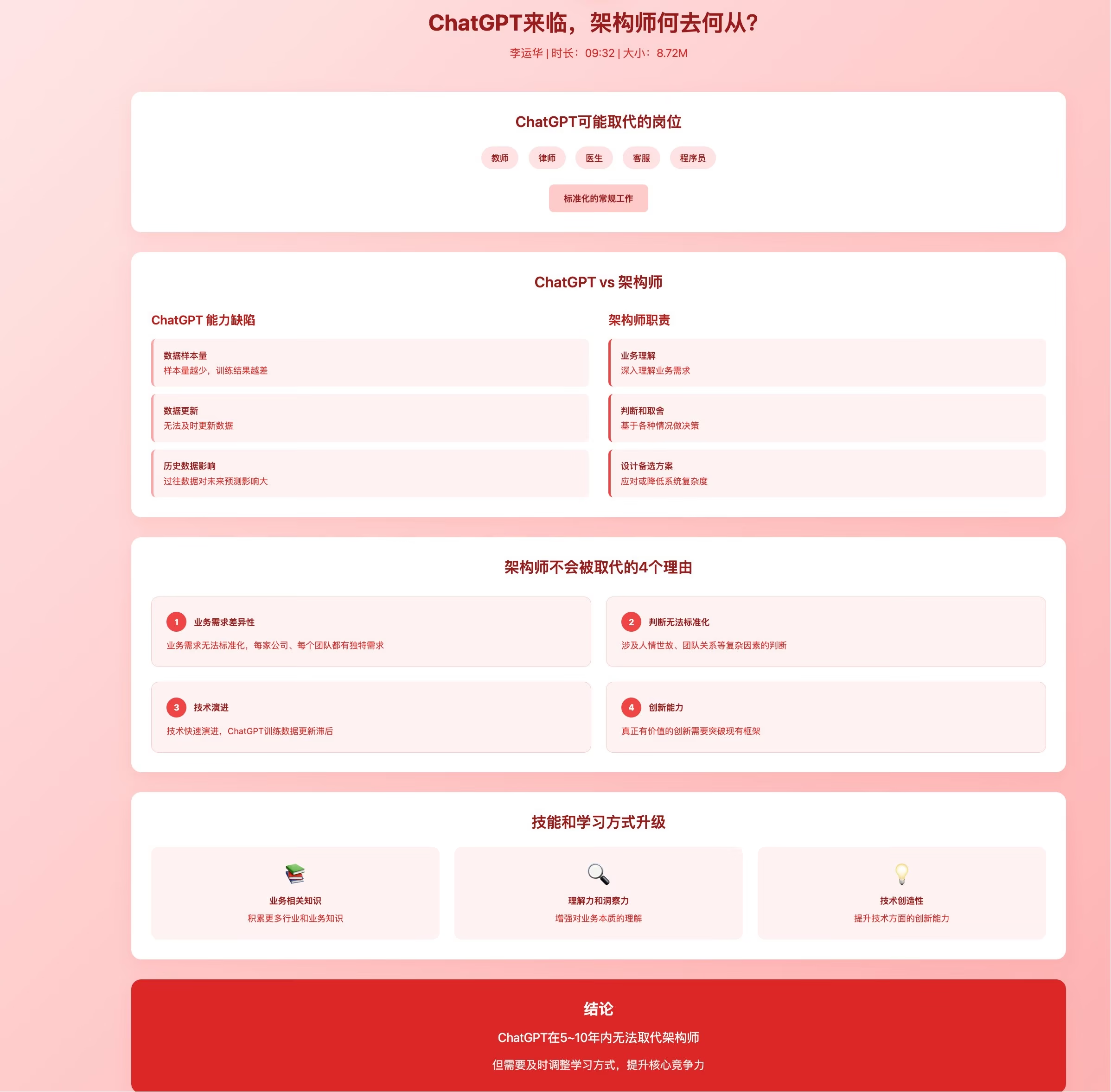
Can AI replace software architects within ten years? Baoyu shared Li Yunhua's perspective from Geek Time, suggesting that as long as AI still mimics human coding and has limited context windows, architects will remain indispensable. 🤔 However, he also warned that if AI development models undergo a fundamental change, architects must keep up and be among the first to master AI-assisted architecture. As he said (AI News), continuous learning is the survival rule in the software industry, and architectural design skills will never go out of style. Spot on! ✅
-
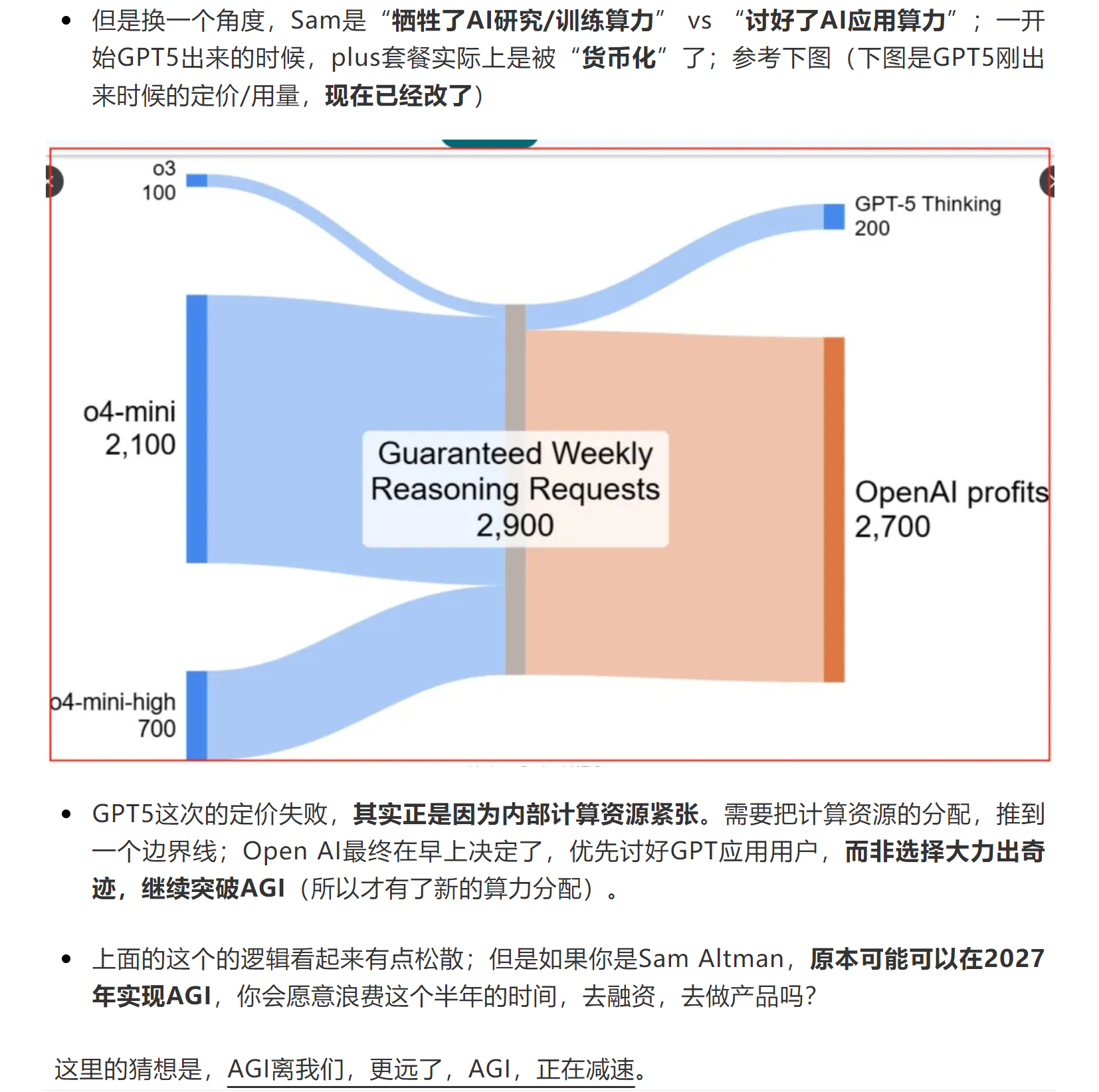
A series of controversies following GPT-5's release have made some folks feel that AGI (Artificial General Intelligence) is actually further away from us. 🤔 Blogger Broad Ocean shared his view, suggesting that the real-world experience language models can access is just the tip of the iceberg, and true AGI might only be achievable through interaction with the physical world. This aligns perfectly with Professor Fei-Fei Li's "world model" approach, emphasizing the importance of embodied intelligence for achieving AGI. This view (AI News) has sparked widespread discussion. Food for thought! 🧠
-
Just how brutal is the world of independent developers? orange.ai shared a heartbreaking story: a Xiaohongshu (a Chinese social media platform) note-generating app with 3 million users that only charged 9.9 RMB per month, but ultimately received payments from just two users. 😭 This shocking conversion rate (AI News) sparked a heated discussion and revealed the extreme difficulty of finding a sustainable business model even with a massive user base. This might just be the cold, hard reality every independent developer dreaming of changing the world with their product has to face. Ouch. 😔

-
Emad, the founder of Stability AI, has been absolutely raving about Google's AI Studio, calling it the best AI interface out there, especially gushing over features like "forking conversations." 🤩 He expressed a strong desire for an open-source version that could connect to any AI model and was super impressed by Gemini's powerful 1 million context window when integrating massive amounts of information. From his share (AI News), it's clear that an excellent user interface is crucial for unleashing the full potential of large models. So true! ✨
AI Product Self-Recommendation: AIClient2API ↗️
Are you tired of constantly switching between different AI models, with annoying API rate limits tying your hands? Well, guess what – you've got an ultimate solution! 'AIClient-2-API' isn't just a regular API proxy; it's a magic box that can "turn lead into gold," transforming tools like Gemini CLI and Kiro clients into powerful OpenAI-compatible APIs. ✨
The core charm of this project lies in its "reverse thinking" and powerful features:
✨ Client to API, Unlocking New Moves: We've cleverly leveraged Gemini CLI's OAuth login, letting you easily break through the rate and quota limits of official free APIs. Even more excitingly, by encapsulating Kiro client interfaces, we've successfully cracked its API, allowing you to seamlessly call the powerful Claude model for free! This offers you an "economical and practical solution for programming development using free Claude API plus Claude Code."
🔧 System Prompts, You're in Control: Want to make your AI more obedient? We offer powerful System Prompt management. You can easily extract, replace ('overwrite'), or append ('append') system prompts in any request, fine-tuning AI behavior on the server side without needing to modify client code. 🎯
💡 Top-Tier Experience, Budget-Friendly: Imagine this: using Kilo Code Assistant in your editor, adding Cursor's efficient prompts, and then pairing it with any top-tier large model – why even stick to Cursor if you can get this combo? This project lets you assemble a development experience comparable to paid tools at an extremely low cost. Plus, it supports MCP protocol and multimodal inputs like images and documents, so your creativity knows no bounds. Unleash it! 🚀
Say goodbye to tedious configurations and hefty bills, and embrace this new AI development paradigm that's free, powerful, and flexible all in one! 🙌
AI News Daily Voice Edition
| 🎙️ Xiaoyuzhou | 📹 Douyin |
|---|---|
| Afterlife Tavern | Self-Media Account |
 |
 |
AI Sci-Fi Novel - "The Stargazer"
Chapter Twelve: The Door That Shouldn't Have Been Opened
Time: Seven years after the Pandora Incident
"Welcome to 'Star Capsule,' awaken your inner potential. Just ten minutes to experience the genius's perspective."
In the crowded subway car, a flexible screen continuously played this advertisement. The ad's visuals were stylish and tech-forward: a weary office worker entered a futuristic "experience pod," putting on a headset resembling a brain-computer interface. Ten minutes later, he emerged invigorated, his eyes gleaming with intelligence. The complex data reports that once baffled him now seemed as simple as a child's drawing.
In the bottom right corner of the ad was a small logo—a brain encircled by a star halo.
Lin Yao stared expressionlessly at the advertisement, her fingers unconsciously tapping on the armrest of her wheelchair.
After the "Pandora" incident, governments worldwide had enacted the strictest laws, prohibiting any gene editing targeting human germline cells and any human augmentation experiments related to the "Stargazer gene." That door to "transhumanism" seemed to have been slammed shut for good.
But human desire always finds the trickiest loopholes.
The "Star Capsule" was a grey industry that had swept across the globe in the past two years. It didn't involve gene editing; instead, it used a combination of "Transcranial Magnetic Stimulation (TMS)" and "neural sound wave resonance" to temporarily and limitedly simulate the "semi-activated" state of the "Stargazer gene" for short periods.
It allowed ordinary people to experience accelerated thought speed, enhanced logical abilities, and soaring pattern recognition skills for one to two hours. For students facing crucial exams, programmers handling complex solutions, or artists seeking creative inspiration, this was a deadly allure.
It was like an "intelligence stimulant."
"We've received an alert from the Oana Foundation," Ava Jensen's voice came through Lin Yao's bone-conduction headphones.
The "Oana Foundation" was an unofficial organization Lin Yao named after the woman in Keli's story, dedicated to monitoring the abuse of gene technology globally. "It's like Oana, guarding the spark Keli left behind, preventing its abuse and desecration," Lin Yao had once explained.
"Another incident?" Lin Yao asked softly.
"Yes, in Tokyo," Ava's tone was heavy. "A high school student named Kento Nakajima, trying to pass his university entrance exams, used 'Star Capsule' for over eight hours daily for a week straight. Yesterday, he set fire to all his books and notes at home. When found, he was sitting on the roof, talking to the moon. He said he saw the 'noise of the universe,' and that human language and text were 'pollution' to truth."
Lin Yao closed her eyes.
This was already the fifth such incident in the past three months. They called it "Cognitive Collapse Syndrome."
Abusing "Star Capsule" didn't truly turn people into geniuses. It was like a potent drug, forcefully prying open a door in ordinary brains that should have remained tightly shut, allowing them a glimpse into the grand and chilling world beyond. However, their brains lacked the matching hardware structure—unlike true "Stargazers"—that could process and withstand such an onslaught.
The result was that the thread of their sanity was completely severed by an incomprehensible, massive torrent of information. They became true "lunatics," forever lost at the boundary between reality and hallucination.
"We can't just stand by anymore," Lin Yao said. "Ava, help me contact 'Leukocyte.'"
"Leukocyte" was a semi-official action group secretly assembled by Professor Chen after the "Pandora" incident, leveraging his influence and connections. It consisted of top hackers, former intelligence agents, and legal experts. Their duty was just like the human body's immune system: to eliminate the "cancer cells" that threatened the overall "health" of human society.
Lin Yao arrived at a teahouse nestled deep within the old city. The owner, a seemingly inconspicuous middle-aged man, personally led Lin Yao to a quiet private room.
"Dr. Lin," the middle-aged man respectfully offered a cup of tea, "'Leukocyte' has tracked down the largest technology supplier behind 'Star Capsule'—a company called 'Echo Tech.' Their servers are located on an offshore data ark in Yokohama, with extremely high physical and network defense levels."
"Who's their founder?" Lin Yao asked.
"Someone you might not expect," the middle-aged man pulled up a holographic projection, revealing a familiar face.
That person had once been one of the core scientists at the "Pandora" base, successfully escaping during the chaos of that time and absconding with a portion of the "Stargazer gene" simulation data. Unlike Lin Yao, who reflected and guarded it, he chose to turn this "forbidden knowledge" into a profitable commodity.
"He opened a door that shouldn't have been opened," Lin Yao's voice was icy. "Now, we have to close it."
"Forcibly destroying the data ark would trigger massive international disputes and public outrage," the middle-aged man warned.
"I don't need to destroy it," a sharp glint flashed in Lin Yao's eyes. "I just need to... deliver them a 'medical record.'"
That night, Lin Yao returned to her research center. This time, she didn't seek help from the "Kli" program. She knew that once that program intervened, its power would be immeasurable, potentially causing a disaster across the entire cyber world.
She decided on another approach.
She pulled up the brain activity records of Kento Nakajima and several other "Cognitive Collapse Syndrome" patients. These records, which seemed like chaotic and meaningless noise to ordinary people, were a unique "language" in Lin Yao's eyes—a language emitted by brains "formatted" by the vast information of the "Stargazer" world, filled with pain and confusion.
She and her team spent two full days compiling these "painful languages" into a special, highly infectious "neuro-acoustic" signal.
This signal, in itself, had no destructive power. But if it were transmitted through the "Star Capsule" device and acted directly on a person's brain, it would be like a key, precisely unlocking the listener's deepest fear—the most primal terror of facing infinite unknowns, of an individual being as minuscule as a speck of dust.
"We call it 'Echo of the Abyss'," Lin Yao told Ava. "I want those who abuse technology for shortcuts to personally experience a fraction of the pain felt by the victims they pushed into the abyss."
Through 'Leukocyte's' secret channels, this "neuro-acoustic wave" was disguised as a routine system upgrade patch and silently injected into "Echo Tech's" global servers.
The next day, all "Star Capsule" users worldwide heard an unexpected "sound" when undergoing their "potential awakening."
It wasn't language, nor music, but an indescribable "noise" that struck deep into the soul. Some heard the death of stars within it, some the end of time, others the echo of their own consciousness dissolving in the infinite universe.
What they experienced was no longer the "genius's perspective," but the "madman's abyss."
Panic spread at an unprecedented speed. Millions of users globally, after enduring those terrifying ten minutes, smashed their headsets and swore never to touch that damn thing again. The myth of "Star Capsule" was utterly shattered overnight.
"Echo Tech's" stock plummeted, and it quickly declared bankruptcy amidst collective user lawsuits and government investigations. The founder was eventually arrested while attempting to flee.
That door, pried open by desire, was forcefully closed by Lin Yao in a nearly "fight fire with fire" manner.
Yet, there was no joy of victory in Lin Yao's heart.
She sat in her study, looking at Keli's skull fossil. She knew that as long as human desire persisted, as long as the temptation of "shortcuts" remained, if one "Echo Tech" fell today, another "Tide Sound Tech" would emerge tomorrow.
Blocking it was impossible.
The only way out was "guidance."
She picked up the phone and dialed the private number of a high-ranking official at the Ministry of Education.
"Minister, this is Lin Yao," her voice was calm and firm. "Regarding the current education reform, I have an immature suggestion... Can we perhaps reconsider the essence of education? Is it truly about molding everyone into identical 'standard parts,' or is it about helping each individual find their own unique 'starry sky'?"
She knew this was a thousand times harder than shutting down a company. This was a longer, more arduous war, its battlefield not in cyberspace, nor in reality, but within the mindset of every single person.
But she had to do it.
Because Keli's story had taught her that a species' true strength didn't lie in possessing an omnipotent "god," but rather in every ordinary individual having the courage to think independently and gaze at the stars.