
16 KiB
linkTitle, title, breadcrumbs, next, description, cascade
| linkTitle | title | breadcrumbs | next | description | cascade | ||
|---|---|---|---|---|---|---|---|
| AI Daily | AI Daily-AI资讯日报 | false | /en/2025-12/2025-12-16 | Your daily source for curated AI news, practical tools, and actionable tutorials to master Artificial Intelligence; |
|
AI Daily Digest 2025/12/17
AI News|Daily Brief|Web Data Aggregation|Cutting-Edge Science Exploration|Industry Voices|Open Source Innovation|AI & Human Future| Visit Web Version | Join Group Chat

Today's Rundown
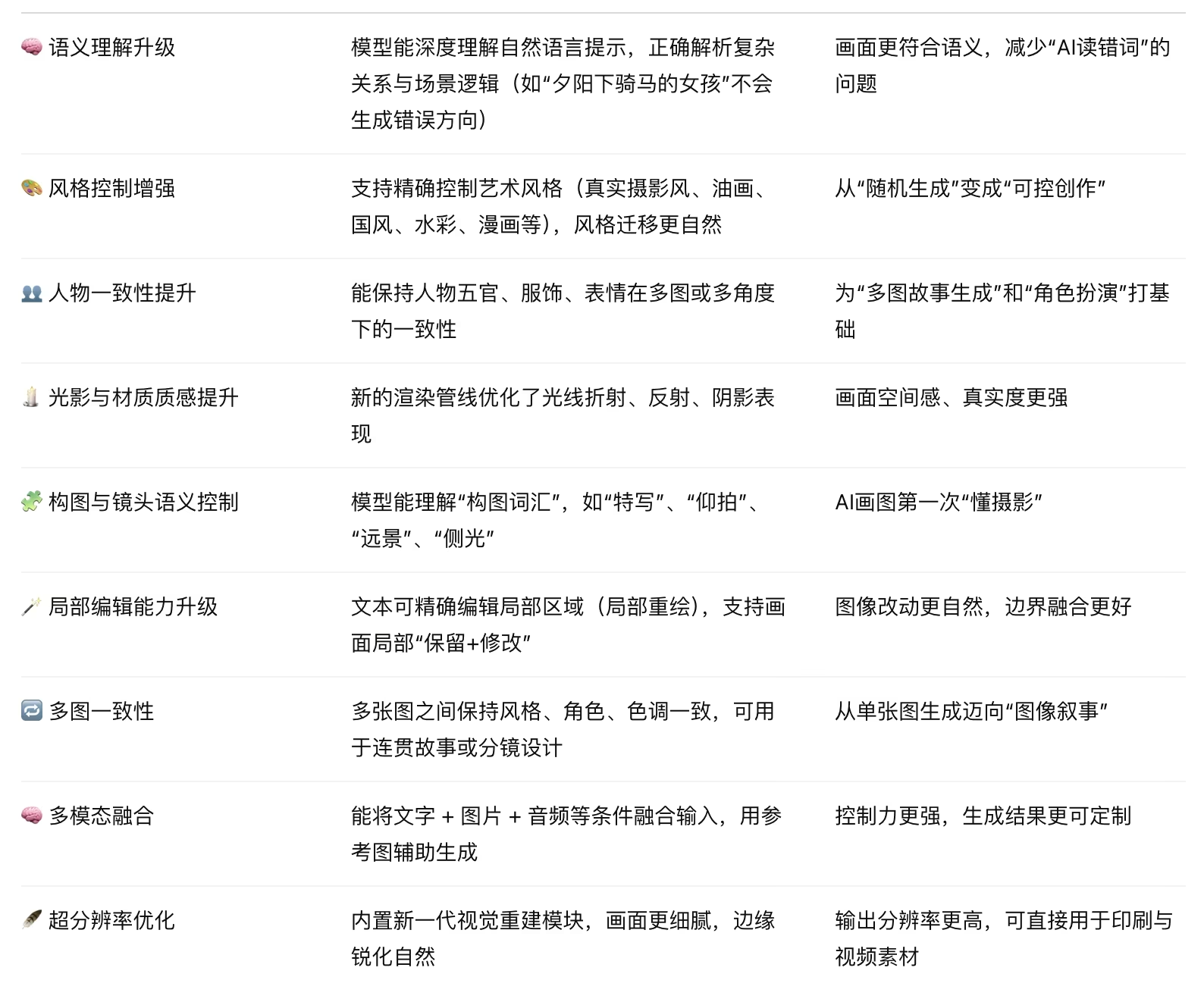
Alibaba Wan 2.6 model supports role-playing with fifteen-second native audio-visual synced video.
Nvidia releases Nemotron 3 series Nano model, 3 billion parameters, fourfold throughput increase.
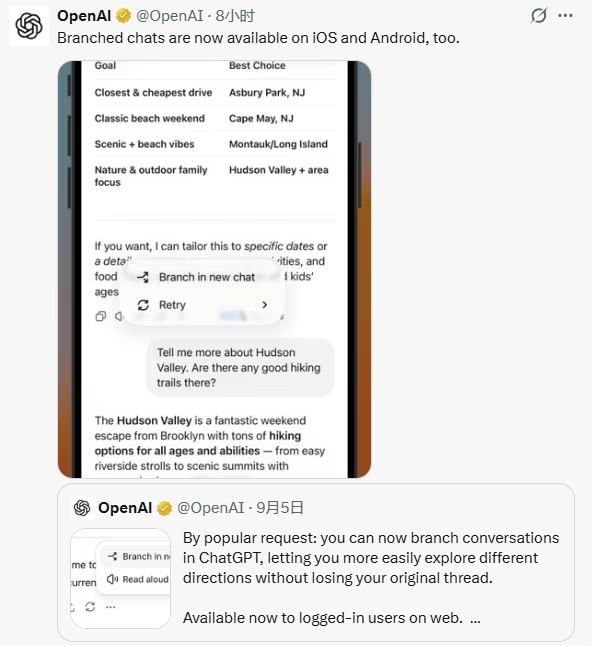
ChatGPT launches branch chat feature, supporting multi-threaded conversations to prevent information loss.
Peking University team reveals LLM delicate balance phenomenon, generating content via potential functions.
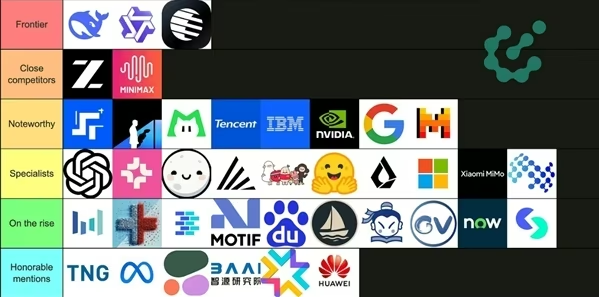
DeepSeek and Qwen tie for top spot on open-source model list, over half from Chinese teams.
Product & Feature Updates
-
Alibaba Tongyi Wanxiang Gets Another Upgrade! Alibaba's Tongyi Wanxiang has just leveled up, launching its Wan 2.6 Video and Image Model (AI News)! This bad boy is the first in China to support role-playing features. You can now churn out videos up to 15 seconds long, complete with native audio-visual sync and custom audio support. Plus, it's packed with new goodies like scene-level control, multi-person scene shooting, and significantly improved instruction following capabilities. Text-to-image generation? It's nailing style details, making it perfect for short drama production. Check it out!
-
Nvidia Drops the Nemotron 3 Series! Nvidia's Nemotron 3 is here, featuring three spicy open-source models: Nano (30 billion parameters), Super, and Ultra. These models rock a Mamba-Transformer hybrid MoE architecture. The Nemotron 3 Nano, activated with only 3.2 billion parameters (AI News), boasts a 4x throughput boost compared to its predecessor and handles a million-token context. You can grab it now for download on Hugging Face (AI News), and it comes with the Taobao-MM 3 trillion-token training dataset and the NeMo Gym reinforcement learning library. What a deal!
-
ChatGPT Unleashes Branch Chat Feature! OpenAI has rolled out a cool new branch chat feature for ChatGPT on iOS and Android. Users can now create multiple parallel conversation branches, letting them explore new directions based on the original discussion (AI News). This function is a game-changer for multi-threaded scenarios like business strategy and creative writing, preventing info from getting lost in linear chats and boosting overall interactivity and creativity. Super handy!
-
Kuaishou's KAT-Coder-Pro V1 Climbs to the Top! Kuaishou's Agentic Coding model, KAT-Coder-Pro V1, has officially taken the stage (AI News), scoring a whopping 64 points in the Artificial Analysis evaluation. This puts it ahead of Claude 4.5 Sonnet, cracking the overall Top 10! Not only that, but it also snatched the number one spot in the non-inference model rankings. What's even cooler? Its token consumption is way lower than comparable models, delivering some serious bang for your buck. Awesome sauce!
-
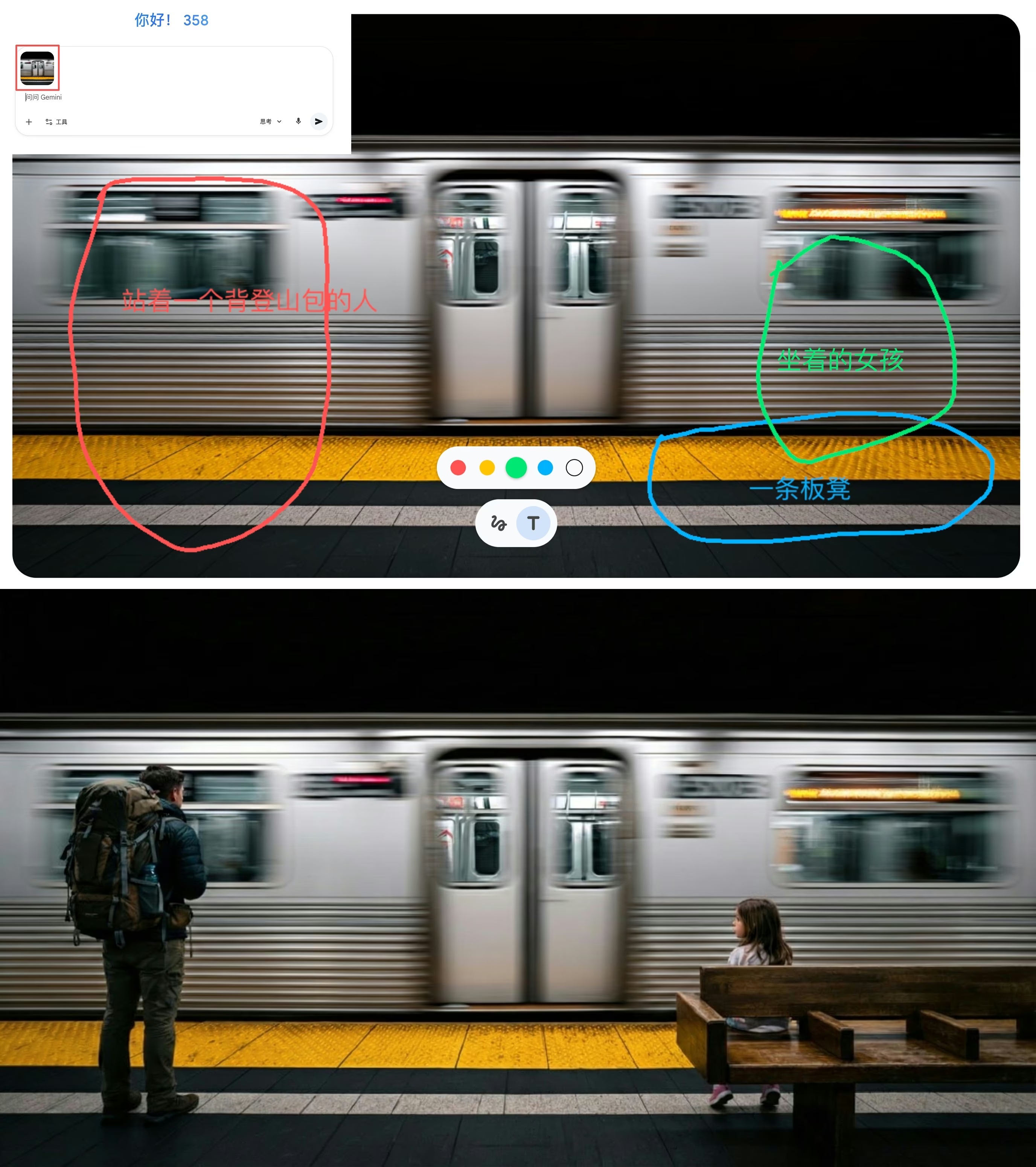
Gemini Gets a Sweet Image Markup Feature! Google Gemini just got even better, now letting you add text and line markings when uploading images. This means super precise control over object positioning and content modification. The best part? All markings are automatically removed once you're done (AI News). Just use the simple prompt: "Modify according to the markings, delete markings," and boom – significantly enhanced image editing accuracy. Talk about smart!
Cutting-Edge Research
-
Peking University Physics Team Uncovers LLM Dynamics! A squad from Peking University's School of Physics has made a groundbreaking discovery, unveiling a "delicate balance phenomenon" in LLM generation through the Principle of Least Action (AI News). Their research suggests that LLMs generate content by implicitly learning potential functions rather than rigid rule sets, behaving much like thermodynamic equilibrium systems. Interestingly, Claude-4 tends to converge quickly, while GPT-5 Nano is more inclined to explore state space. This theory is a game-changer, elevating AI research from mere "alchemy" to a quantifiable science. Mind blown!
-
Harvard Dives Deep into Perplexity User Data! A Harvard study (AI News), based on hundreds of millions of queries, reveals some cool insights into Perplexity users. It turns out 55% use it for personal stuff, while 30% are in professional settings. Productivity/workflow queries make up a solid 36%, with learning and research at 21%. What's really neat is how users shift from simple to more complex tasks over time, giving us a genuine snapshot of agent usage. Pretty telling, right?
-
Stanford Unveils Multimodal DiffFusion Framework! Stanford has introduced a slick new framework that leverages diffusion models for 3D object detection in adverse weather (AI News). How cool is that? Diffusion-IR steps in to fix images, while PCR compensates for LiDAR data. The BAFAM module then swoops in for dynamic multimodal fusion and bidirectional BEV alignment. This combo shows optimal robustness across three major public datasets, with zero-shot tests proving its awesome generalization capabilities. Seriously impressive!
-
Causal LLMs Get a Text Classification Deep Dive! A new study (AI News) is pitting two fine-tuning strategies against each other for Causal LLMs text classification: embedded vs. instruction-based. The embedded approach, which mixes 4-bit quantization and LoRA, trains an 8B parameter model on a single GPU and absolutely crushes the instruction-based method in F1 scores. What's even wilder? Its performance on proprietary datasets and WIPO-Alpha multi-label tasks even outshines domain-specific models like BERT. Talk about a powerhouse!
-
Google Cloud Unveils AlphaEvolve! Google Cloud has just dropped AlphaEvolve, a Gemini-powered coding agent (AI News) that's all about advanced algorithm design. This agent leverages LLMs to whip up code modification suggestions, using a feedback loop to evolve algorithm efficiency. It's currently in private preview, but the promise is clear: higher code quality is on the horizon. Watch out, coders!
Industry Outlook & Social Impact
-
OpenAI & Anthropic Team Up for Agentic AI Foundation! In a big move, OpenAI and Anthropic have joined forces with Block to establish the Agentic AI Foundation (AI News) under the Linux Foundation. Their mission? To focus on setting standards for agent interoperability. They're pouring funds into supporting a secure and reliable agent ecosystem across various tools and repositories, bringing industry leaders together to align on agent interoperability. This is huge for the future of AI!
-
Stripe Rolls Out Agentic Commerce Suite! Stripe's new service is a game-changer, enabling businesses to sell to multiple AI agents through a single integration. Talk about streamlining! This sweet new offering (AI News) covers everything from product discovery and agent checkout to payments and fraud detection, all managed centrally within the Stripe Dashboard. The AI-native commerce infrastructure is now officially commercial, playing nice with existing commerce stacks. It's a win-win!
-
CAICT Launches CAIVD Professional Database! Under the guidance of the Ministry of Industry and Information Technology, the CAIVD AI Security Vulnerability Database (AI News) is officially up and running! This database is the sixth member of the "1 Master Database + 5 Professional Databases" system, specifically focusing on collecting and verifying AI product vulnerabilities. It's building a collaborative network for product providers, manufacturers, research institutions, and users, standardizing vulnerability disclosure channels. You can check it out at: ai.nvdb.org.cn. Major step for security!
-
Homegrown Open-Source Models Tie for Top Spot! According to the open-source large model list (AI News) released by AI researcher Nathan Lambert, DeepSeek, Qwen, and Kimi have been ranked as tied for first place in terms of influence! The list features 35 organizations, with over half being Chinese teams. DeepSeek R1 has even surpassed top-tier closed-source models, Qwen has spawned dozens of cross-domain versions, and Kimi dropped the world's first trillion-parameter open-source model. Talk about flexing!
-
Former CIA Officer Revives Remote Control Tool Claims! Former CIA officer Kiriakou stirred up some chatter in a LADbible video (AI News), claiming intelligence agencies can remotely control phones, TVs, and cars. However, discussions on Hacker News quickly pointed out that this is just a rehash of the 2017 Vault 7 leaks, not fresh evidence. Commenters are questioning Kiriakou's technical currency and the media's tendency to sensationalize, advising the public to refer to the original leaked documents rather than personal statements. Classic case of old news, new hype.
Top Open Source Projects
-
ConvertX: Your Go-To Self-Hosted File Converter! ConvertX is a total game-changer, supporting over 1000 formats (AI News) and offering full self-hosted deployment. This little gem is super lightweight, doesn't need any third-party services, and is perfect for individuals and businesses looking to set up their own private file conversion platform. It's already snagged 11.2k stars – clearly a fan favorite!
-
MDN Web Docs Content Repository: The Dev's Best Friend! The MDN Content Repository (AI News) is the official source for MDN Web Docs, boasting over 14,000 pages of HTML, CSS, JS, HTTP, and Web API documentation. Developers can jump right in and contribute content directly. It's already racked up 10.2k stars, making it a true dev darling!
-
Hashcards: Your Minimalist Spaced Repetition Buddy! Hashcards is a cool, text-based tool for spaced repetition learning (AI News). No fussy configurations needed here – it supports Markdown formatted cards and offers lightweight deployment. It's already garnered 629 stars, proving that sometimes, less is more!
-
SPEC-AGENTS: The Zero-Config Spec-Driven Dev Framework! SPEC-AGENTS is shaking things up with a zero-configuration, spec-driven development tool (AI News). It lets you communicate in natural language, breaking development into different stages and supporting switching between multiple programming tools without losing progress. This document-driven workflow creates a traceable closed loop, letting even regular users enjoy a mature software development process. Pretty neat, right?
-
Nvidia Acquires SchedMD, Stays Open Source! Big news in the tech world: Nvidia has acquired SchedMD, the main developer behind Slurm (AI News)! They've promised to keep Slurm operating as an open-source, neutral platform. Slurm is already the benchmark workload management system in high-performance computing and AI, so this is a big deal. Nvidia also simultaneously released the Alpamayo-R1 inference vision model and relaxed licensing for the Cosmos world model, really laying the groundwork for a physical AI ecosystem. Exciting times!
Social Buzz
-
Alibaba's Agentification: A Deep Dive! A community discussion (AI News) highlighted that Ant Group products are the most gung-ho about agentification. Why? Because their tool-centric nature prioritizes results over process. Taobao's agentification, however, needs to balance its "portal attribute" ad revenue. Meanwhile, WeChat's enthusiasm is a bit lower since it thrives on "usage process" interaction. Users reckon this isn't strategic restraint but rather a commercial model constraint. Makes sense!
-
The Irony of AI Supervision: Automation's Old Foes! Hold up! A 1983 paper (AI News) eerily predicted automation issues that are now popping up with AI agents: think skill degradation, memory retrieval woes, and monitoring fatigue. The paper smartly pointed out that training can't replace real-world experience, and humans struggle to stay vigilant when AI messes up. But here's the kicker: AI interfaces are often described as "the worst anomaly detection designs," hiding critical errors within reams of flowing text. Talk about a wake-up call!
-
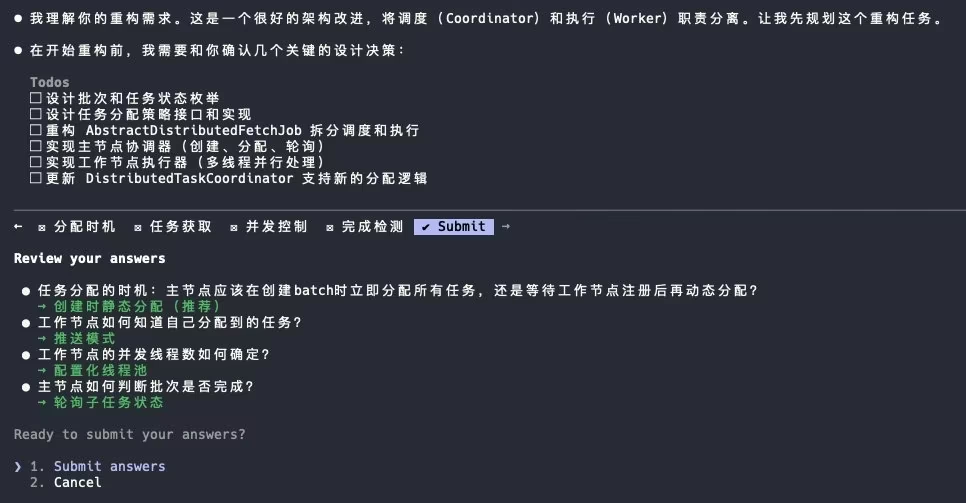
Claude Code's New Confirmation Mechanism: A Smooth Ride! A user shared (AI News) that the new version of Claude Code boasts a super comfortable interactive experience thanks to its confirmation mechanism. Before the agent executes, it pops up a detailed operation preview, letting users review and confirm each item. This is a brilliant way to prevent accidental modifications. Nice touch, Claude!
-
Dismissing AGI as Sci-Fi? That's Not Serious! A Reddit discussion (AI News) argues that writing off AGI discussions as "science fiction" is "completely unserious." Even skeptical experts believe AGI could be a reality in the next ten to twenty years. That's a whole different ballgame compared to genuine sci-fi concepts like time travel or Martians, right? Time to get real!

AI Daily Digest: Audio Edition
| 🎙️ Xiaoyuzhou | 📹 Douyin |
|---|---|
| Next Life Tavern | Self-Media Account |
 |
 |