Your daily source for curated AI news, practical tools, and actionable tutorials to master Artificial Intelligence;
type
docs
AI News Daily 2025/11/1
AI News | Daily Briefing | Aggregated Data | Cutting-Edge Science | Industry Voice | Open Source Innovation | AI & Human Future | Visit Web Version | Join Group Chat
Today's Headlines
Moonshot AI has released its new Kimi Linear architecture, significantly reducing memory usage for long text processing.
OpenAI launched Aardvark, an autonomous security research agent that automatically finds and fixes software vulnerabilities.
In industry news, Agibot's co-founder predicts preliminary AGI after GPT-6.
AI creation platform LiblibAI closed a $130 million funding round, setting a record for China's AI application sector this year.
Amazon plans to invest $125 billion in AI infrastructure, intensifying the AI race.
Product & Feature Updates
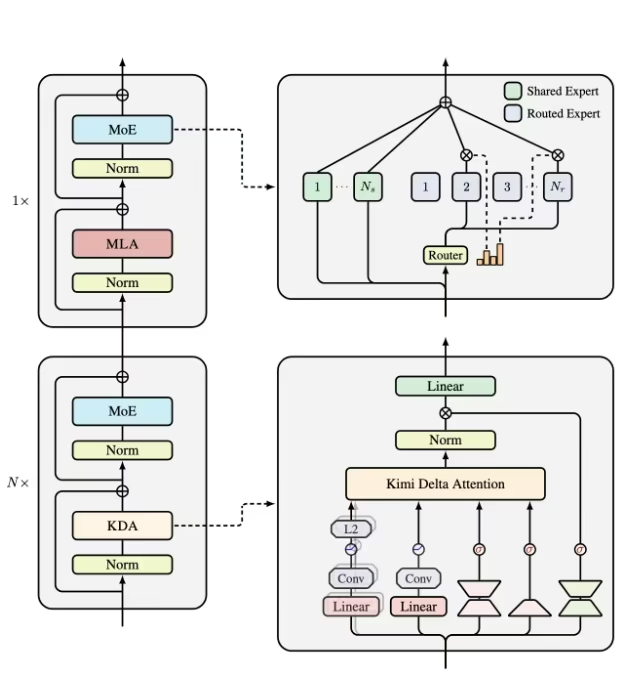
Moonshot AI has unveiled "Kimi Linear", a brand-new hybrid linear attention architecture engineered for efficient processing of both short and long-range information, outperforming traditional full attention methods in various scenarios. Its core technology, Kimi Delta Attention (KDA), optimizes RNN memory management through refined gating mechanisms. This innovation slashes KV cache occupancy by 75% and boosts decoding throughput by up to 6 times when handling 1M token data. This innovative architecture brings significant performance improvements to AI applications, proving exceptional in information-dense tasks. ✨Check out the full tech report here!
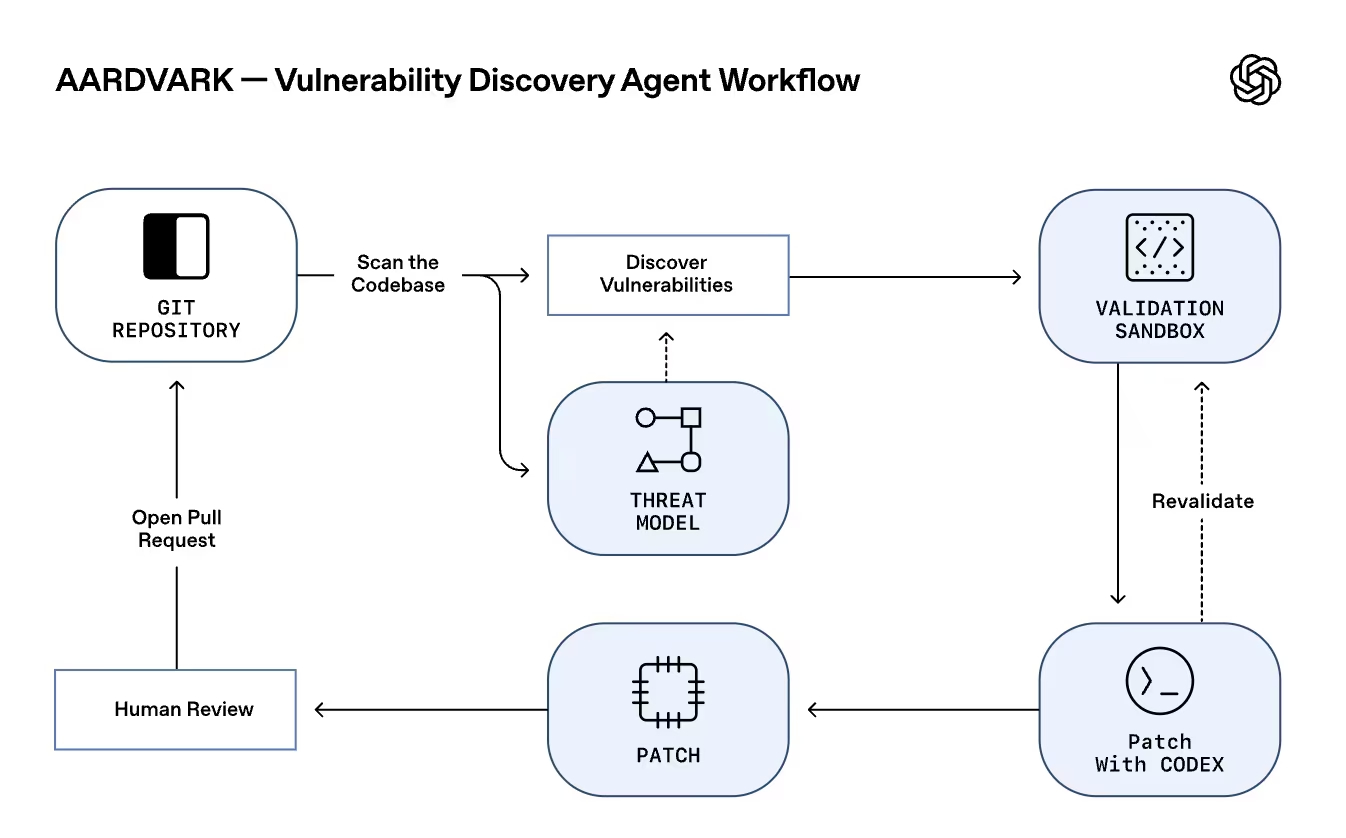
OpenAI has officially launched Aardvark, an autonomous security research agent powered by GPT-5. This 24/7 digital security expert tirelessly "patrols" codebases, automatically discovering and fixing software vulnerabilities. Aardvark understands code logic, validates vulnerabilities in a sandbox, and can even auto-generate patch fixes using Codex, submitting comprehensive vulnerability reports, validations, and solutions all at once. Its arrival signals a shift in software security from "passive detection" to "intelligent defensive automation", with AI becoming an indispensable player in the security landscape. 🤖Private beta applications are now open!
Figma, the design collaboration behemoth, announced its acquisition of Weavy, a one-year-old AI generation startup. Weavy will be integrated into a new sub-brand, Figma Weave, marking Figma's official entry into the AI-native content generation arena. Weavy's core innovation lies in its "node-based" workflow, allowing users to freely combine and remix outputs from different AI models on an infinite canvas. It's like a "mixing console" for layered editing and iteration of images and videos, enabling an all-in-one creative process from exploration to finalization. This acquisition signals a consolidation phase in AI design platforms, with Figma accelerating its transformation into the design operating system for the AI era, liberating creativity from the constraints of single models. 🎨Read more about Figma's AI push!
Canva has rolled out a brand-new "Creative Operating System", comprehensively upgrading its digital marketing and video editing tools to become a one-stop solution for marketing teams. The new platform, Canva Grow, empowers marketers to design, publish, and leverage AI to track and optimize ad campaigns. Meanwhile, a redesigned video editor and new "forms" tool further streamline the creative process. All these new features are powered by Canva's proprietary design-specific AI models, marking Canva's full transformation from a design tool into a comprehensive AI-powered creative platform, offering users a more seamless and intelligent creation experience. ✨Discover Canva's AI transformation!
Cutting-Edge Research
DARTS, a new drone- and AI-based real-time traffic accident detection system, is making waves. Can drones become traffic cops? This system can detect and verify collision accidents up to 12 minutes earlier than traditional traffic management centers. Leveraging the high mobility of drones and thermal imaging technology, combined with a lightweight deep learning framework, DARTS achieves 99% detection accuracy and can monitor accident-induced congestion in real-time. This research offers fresh insights for building more flexible and responsive intelligent traffic management systems, holding immense potential, especially in remote areas and resource-limited environments. 💡Dive into the research paper!
BasicAVSR, a new baseline model proposed in a recent paper, is tackling the challenge of arbitrary-scale video super-resolution. This has always been a tough nut to crack in tech! By cleverly integrating four key components, BasicAVSR significantly enhances video enhancement quality, generalization, and speed. The model utilizes image Laplacian pyramids to generate adaptive multi-scale frequency priors, combined with flow-guided propagation and second-order motion compensation, achieving more precise spatio-temporal information aggregation and alignment. It's truly a "Swiss Army knife" for video restoration! 🎬Its code has been open-sourced on GitHub, providing developers with a powerful video processing tool.
Industry Outlook & Social Impact
Steve Zhou, co-founder of Agibot (Agibot), made a bold prediction at Midea Group's Visionaries Conference: after GPT-6, humanity will enter an era of preliminarily realized Artificial General Intelligence (AGI), and the next wave of AI will be "physical intelligence". He emphasized that embodied AI is the core of AI and robotics integration, representing intelligence's shift from the virtual to the physical world, which will become the most revolutionary industrial trend of the next decade. This perspective reflects the industry's widespread anticipation of AGI and embodied AI convergence, heralding a new era driven by "physical AI". 🔥Explore the future of AGI and embodied AI!
LiblibAI, an AI creation platform, has successfully closed a $130 million Series B funding round, led by prominent institutions like Sequoia China. This marks the largest financing record in China's AI application sector this year! While the company hasn't yet turned a profit and faced early challenges like funding shortages and product delistings, the team successfully turned things around with unwavering faith in the future. Now, they're accelerating their transformation from a model community into a one-stop AI creation studio. This massive funding not only provides LiblibAI with ample "ammunition" but also highlights that in the fiercely competitive AI application space, funding has become a crucial barrier for entrepreneurs. 💰Dig into LiblibAI's journey!
Google and Indian telecom giant Jio have forged a strategic partnership to offer eligible Jio users a free 18-month subscription to the Google AI Pro package, aiming to democratize AI in India. This package includes Google's most advanced Gemini 2.5 Pro model, enhanced image and video generation tools, the NotebookLM research assistant, and 2TB of cloud storage, valued at a whopping 35,100 rupees! This move is a significant step in Google's "AI for All" vision, aiming to empower millions of Indian youth users through the combination of 5G and AI, accelerating the prosperity of the local AI ecosystem. 🇮🇳Learn about Google's "AI for All" initiative in India!
Top Open Source Projects
Looking to build your own Claude Code mirror service or manage multiple large model subscriptions? claude-relay-service (with 4.6k stars on GitHub) is your answer! This all-in-one open-source relay service supports integrating subscriptions from Claude, OpenAI, Gemini, Droid, and more, allowing you to easily "carpool" with friends and efficiently share costs. For developers heavily relying on multiple AI services, this project is undoubtedly a powerful tool for managing and optimizing API costs, making your AI tool experience even better. ✨Check out claude-relay-service on GitHub!
BettaFish (with 2.2k stars on GitHub) is a multi-agent public opinion analysis assistant designed specifically for everyday users. It helps you break free from information bubbles, uncover the true nature of public sentiment, and even predict future trends, empowering you to make smarter decisions. This project was built from scratch without relying on any existing frameworks, aiming to make complex public opinion analysis accessible to everyone. It's a rare "wake-up call" in the information age! 📈Explore BettaFish on GitHub!
ai-engineering-hub (with 20.1k stars on GitHub) is a GitHub repository that's basically your AI engineer's "kung fu manual." If you're looking to dive deep into large language models, RAG, and real-world AI agent applications, this hub has compiled a massive collection of in-depth tutorials and resources for you. Whether you're a beginner or a seasoned developer, you'll find invaluable learning resources here to systematically boost your AI engineering capabilities. 📚Find your AI learning path here!
Social Media Shares
Amazon has also unveiled its astounding AI gamble, following in Google's footsteps. While laying off employees, the company is pouring $125 billion into AI infrastructure development, with its 2025 capital expenditure budget hitting astronomical figures! AWS growth is back to 20%, its in-house Trainium chip business is now multi-billion dollar scale, and Anthropic plans to use 1 million of Amazon's chips by year-end – the entire ecosystem is sprinting full throttle. Amazon's CEO's tough talk, "The faster we scale, the faster we can monetize," reveals the brutal and direct business logic behind this AI race. Only a true "all-in" strategy will let you emerge victorious at the poker table. 🤯Read the full post on X!
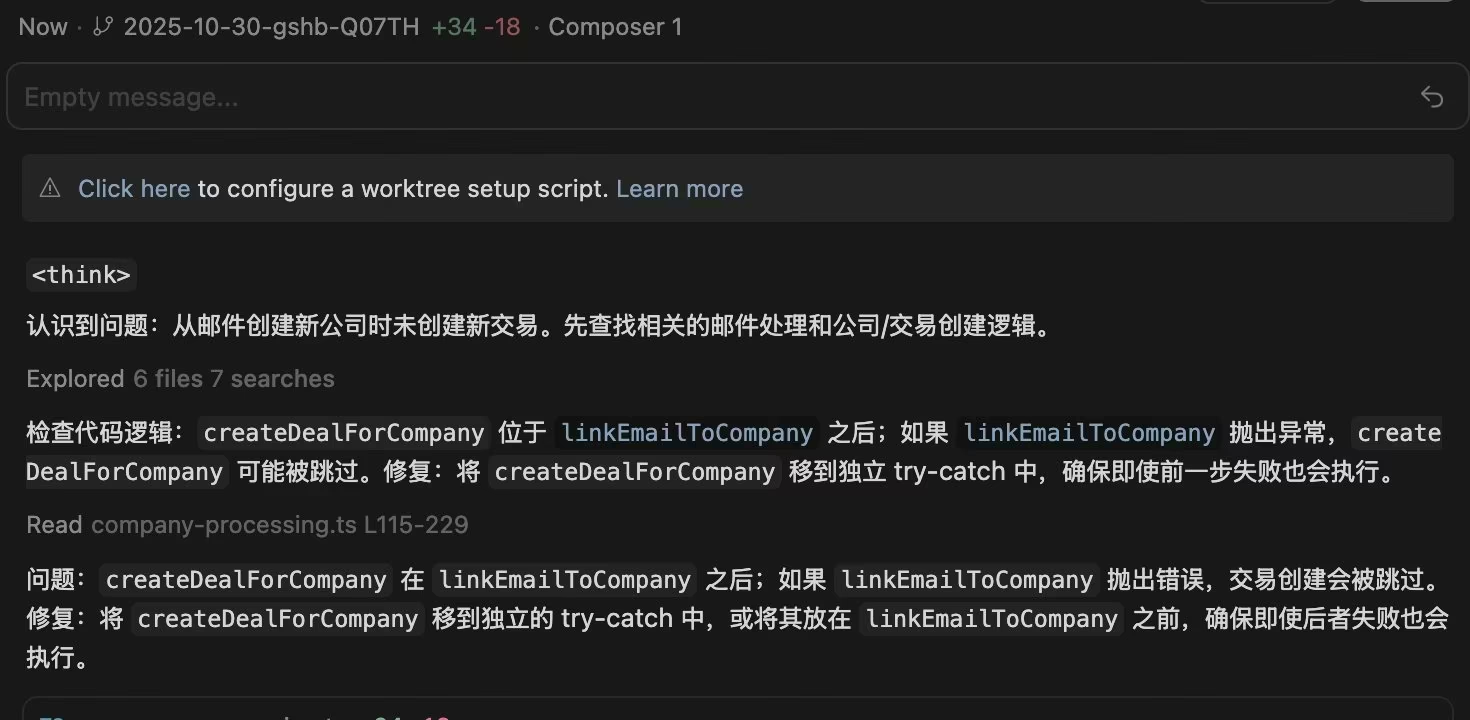
Cursor's recently released Composer-1 model had a funny "bug" discovered by a foreign user: mid-code generation, the model's "inner monologue" suddenly switched to Chinese and couldn't be reverted to English! This left the foreigner baffled and had Chinese users in stitches, playfully remarking, "It's our turn to watch the show!" This little anecdote perhaps unintentionally reflects the quiet rise of Chinese AI models' multilingual capabilities. 🤣See the hilarious bug!
Andrew Ng's recent famous quote is making the rounds in the AI community: "In human history, the distance from having an idea to implementing it has never been shorter than it is now." This brilliantly encapsulates the core characteristic of the AI era – significantly lowering the barrier to innovation and creation, empowering everyone to become a "builder." DeepLearning.AI has also opportunistically launched its Pro membership service, aiming to provide learners with a one-stop path to enhance AI skills and help more people seize this unprecedented historical opportunity. 💡Discover DeepLearning.AI's Pro membership!
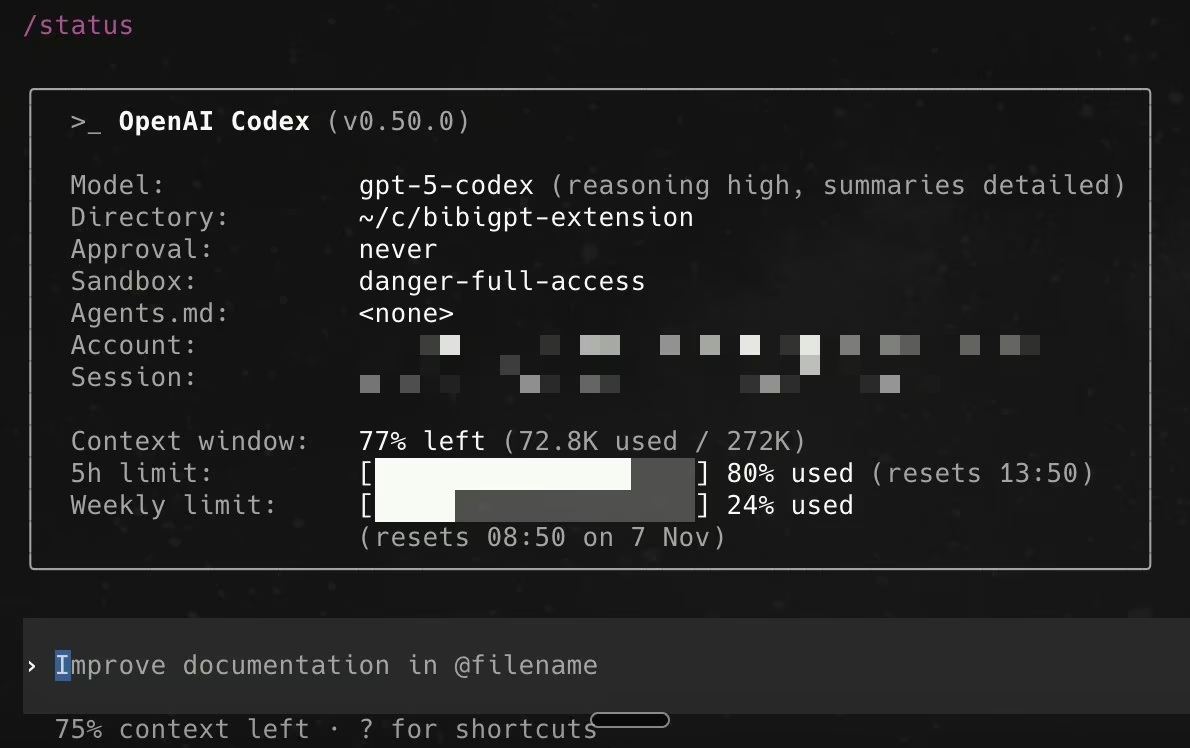
OpenAI Codex has finally rolled out a flexible pay-as-you-go credits purchasing option, which is undeniably fantastic news for developers everywhere! This means that once your free tier runs out, you can top up anytime, without stressing over expensive, usage-based billing models. This move might challenge the payment models of third-party tools like Cursor, and it also allows developers to use the powerful Codex capabilities more freely and affordably. ✨Get your OpenAI Codex credits now!
AGI's greatest threat might not be the safety concerns often depicted in sci-fi films, but rather the straightforward issue of employment. When companies realize that buying GPUs is more cost-effective than hiring employees, large-scale job displacement becomes inevitable. Some argue that employment isn't just an economic necessity but also a social mechanism that fulfills human spiritual needs, something Universal Basic Income (UBI) can't provide. Therefore, the new opportunities for the content industry in the AGI era might lie in creating products that provide spiritual fulfillment even when humans don't need to work—a "mind gym" for idle souls. 🤔Ponder the future of work in the AGI era!