
32 KiB
linkTitle, title, breadcrumbs, next, description, cascade
| linkTitle | title | breadcrumbs | next | description | cascade | ||
|---|---|---|---|---|---|---|---|
| AI Daily | AI Daily-AI资讯日报 | false | /en/2025-08/2025-08-14 | Your daily source for curated AI news, practical tools, and actionable tutorials to master Artificial Intelligence; |
|
AI Daily Dispatch 2025/8/15
AI News|Daily Morning Read|All-Net Data Aggregation|Frontier Science Exploration|Industry Free Voice|Open-Source Innovation Power|AI and Human Future| Visit Web Version↗️
Today's Brief
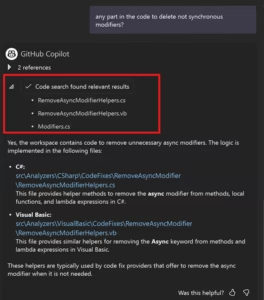
Visual Studio Copilot upgraded to semantic search; Google Gemini also deeply integrated into VS Code.
Kimi is set to launch PPT generation, and the new model nano-banana excels in image editing.
An open-source tool named UnMarker can remove AI watermarks, sparking thoughts on tech offense and defense.
ByteDance and Tencent open-sourced an Agent model and an interactive game video generation framework, respectively, giving back to the community.
Academia proposed the first paper-to-video agent system, continuously expanding AI application scenarios with innovation.
Product & Feature Updates
- Visual Studio Copilot Chat just got a major brain boost! It's finally ditching the old-school BM25 keyword matching and fully embracing smart remote semantic search technology 🚀. This means it truly gets what you're trying to do. For example, if you search "get user credentials," it won't just blindly match exact words; it'll actually find a function like "RetrieveOAuthCredential." This leap makes code search incredibly precise and efficient, letting developers spend way less time on "treasure hunts" and more time on creating. For all the juicy details, click here to check out this in-depth (AI News) report.

- Kimi, from Moonshot AI, is about to drop a global PPT generation feature powered by its super-strong K2 model – get ready for a serious efficiency revolution (✧∀✧)! This MoE (Mixture-of-Experts) model boasts trillions of parameters and has already shown stellar performance in coding, math, and Agent tasks, promising to elevate PPT creation to a whole new level. Say goodbye to those all-nighters tweaking formats and content; the future of smart office work is totally calling our name. Catch more deets in this cutting-edge (AI News) report.

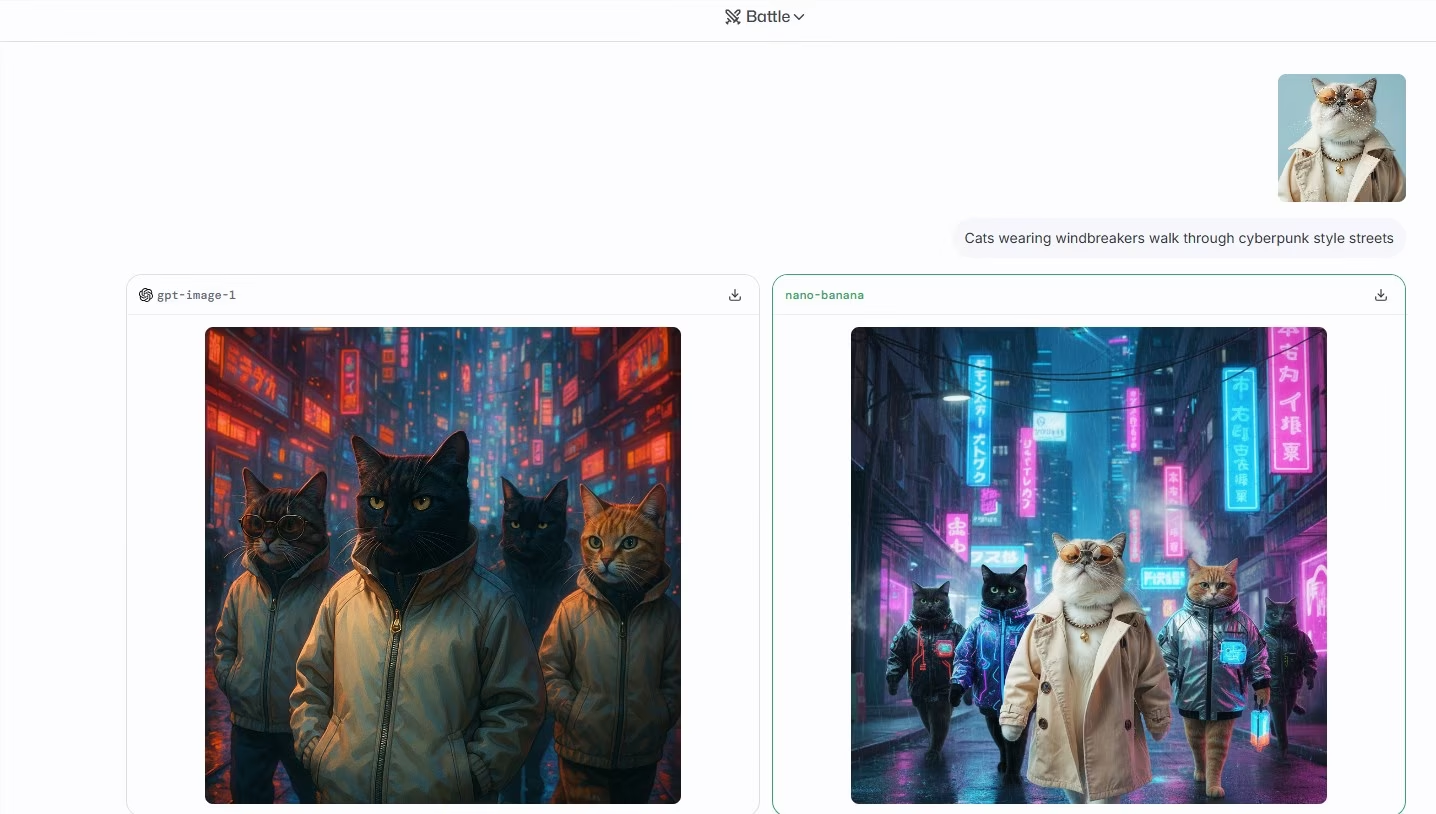
- A mysterious model called nano-banana just popped up quietly on the lmarena platform, and it's already blowing up the community with its "mind-blowing" effects 🔥! Early users are reporting that this model totally outshines the popular FLUX Kontext in its three core abilities: character restoration, scene reconstruction, and image fusion. This dark horse's arrival hints at even more powerful creative tools coming our way for fields like creative design and post-production. Go ahead and experience this new (AI News) product for yourself!
- Google's Gemini CLI tool is now officially super-integrated with VS Code, bringing developers a seamless, smart coding experience 💡. You can now get intelligent suggestions directly within your editor from Gemini, which totally understands your code context, and even use native diff comparison features to easily review and apply changes. This integration seriously streamlines the development process, making coding smoother and more efficient. For more deets, check out this official (AI News) announcement.
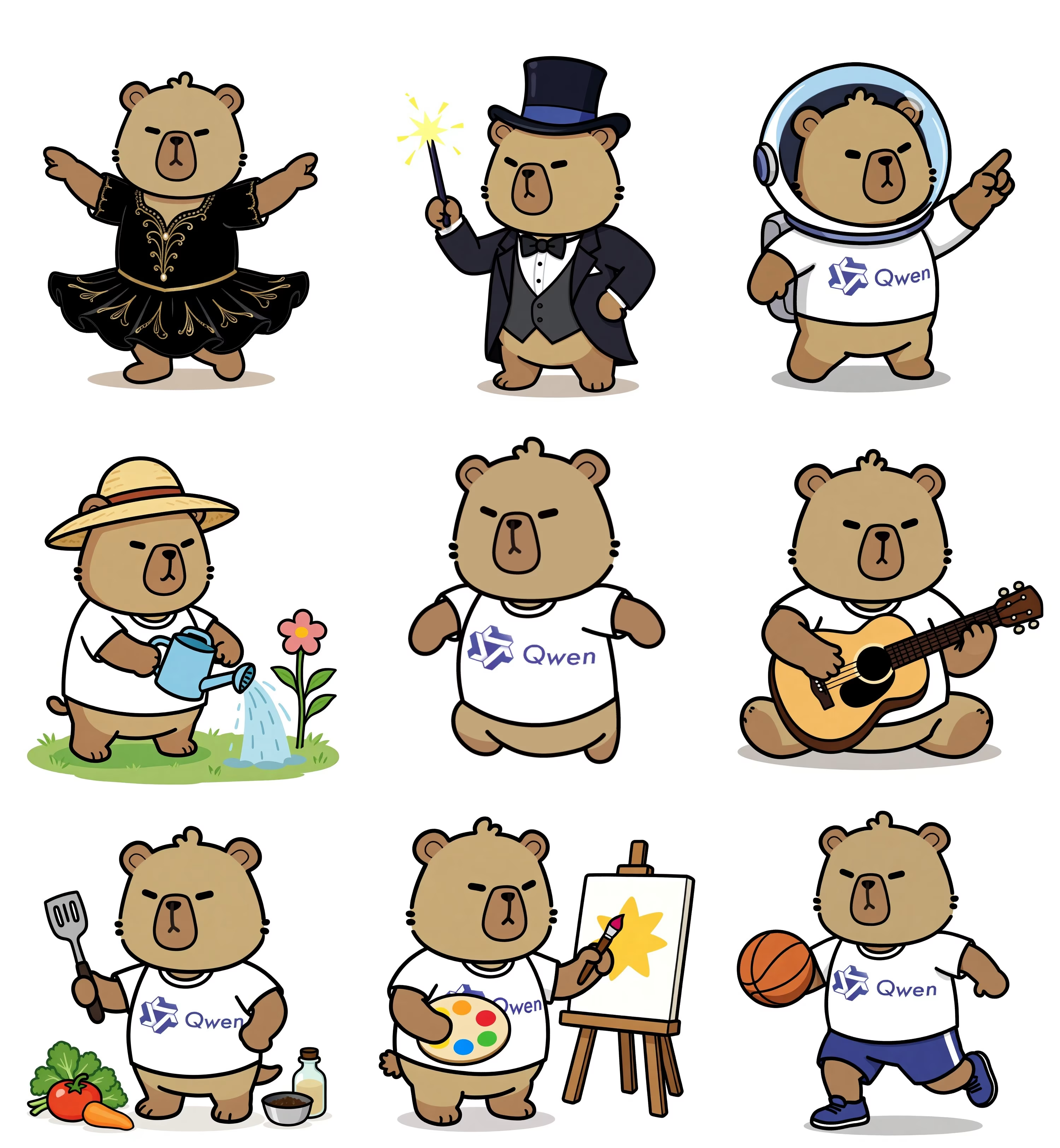
- Qwen Image Edit, the new image editing feature from Tongyi Qianwen, is still deep in development, but the official team couldn't resist dropping a "spoiler" with an adorable capybara test image (o´ω'o)ノ! This Qwen capybara, covered in all sorts of stickers, vividly showcases the new tool's creative potential, making us super excited about its future photo-editing and creation capabilities. Looks like content creators will be getting a cool new toy soon – let's totally look forward to the release of this (AI News) tool!
Cutting-Edge Research
- Traditional methods for scene change detection have been a real headache for academics because defining "relevant changes" is always so ambiguous. But now, ViewDelta, a new research (AI News) paper, proposes a brilliant solution 💡! Researchers have introduced a text-conditioned framework that lets users precisely define the changes they want to detect using natural language prompts, like "only look at building changes" or "ignore vegetation growth." This approach not only tackles the challenge of inconsistent dataset labeling but also trains a versatile model adaptable to various scenarios, basically a "spot-on" eagle eye (✧∀✧)!
- Ever wondered how to transform a dry academic paper into a lively and engaging video summary? Well, Preacher, a research (AI News) paper, introduces the first-ever paper-to-video agent system that totally solves this problem 🤔! This system acts like a professional "preacher," first breaking down and extracting the core ideas of the paper from top to bottom, then generating diverse video clips from bottom to top and synthesizing them into a cohesive video summary. By leveraging innovative Progressive Chain-of-Thought (P-CoT) technology, it successfully overcomes the limitations of current video generation models, making knowledge dissemination more intuitive and efficient than ever before.
- AI coding assistants are awesome, but their "black box" code suggestions often leave you feeling a bit uneasy. Now, CopilotLens, a research (AI News) paper, is working to bust through that opaqueness. Researchers have designed a novel interactive explanation framework that acts like a "lens," visualizing the AI assistant's "thought process" and clearly showing the source and logic behind its code suggestions. This framework aims to help developers better understand and trust AI's recommendations, moving from "blind acceptance" to "critical collaboration," making "human-AI collaborative" programming way more transparent and reliable 🧐.
Industry Outlook & Social Impact
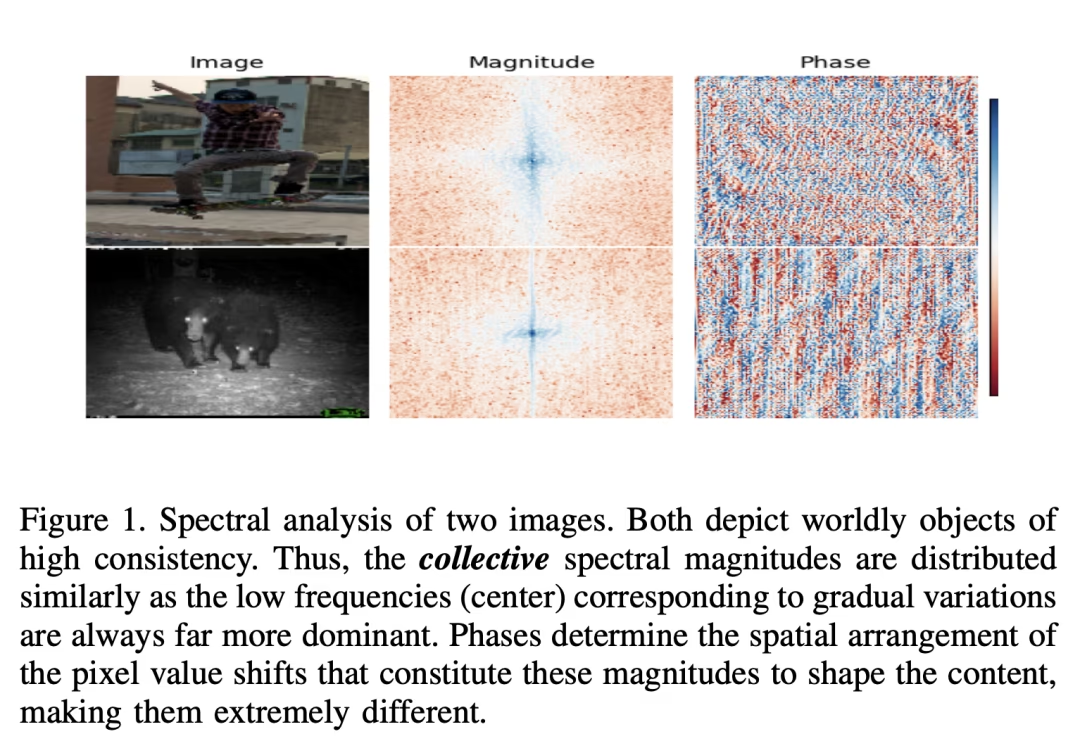
- The "moat" of AI image watermarks is crumbling! An open-source tool called UnMarker can wipe out almost all invisible watermarks on the market in just 5 minutes with a consumer-grade graphics card – even Google's SynthID isn't safe 🔥. It doesn't crack the watermark algorithm; instead, it directly messes with the image's spectral characteristics, making watermarks ineffective by "pulling the rug out from under them." This wild discovery comes from this cutting-edge (AI News) report. This undoubtedly poses a huge challenge to efforts relying on watermark technology for content traceability and combating misinformation, sparking some deep thoughts on tech offense and defense 🤔.
- Imagine creating and exploring virtual worlds directly with your thoughts – this isn't just sci-fi movie stuff anymore! A thought-provoking Reddit (AI News) post introduces the concept of DreamAI 🧠. This idea combines Google's Genie 3 (real-time text-to-3D world generation) with brain-computer interfaces (thought-to-text), letting users instantly generate and change VR environments with their minds. This won't just unlock new interaction dimensions for people with disabilities; it could also totally revolutionize how we create, entertain, and even explore our own imaginations. The future is here (✧∀✧)!
Top Open-Source Projects
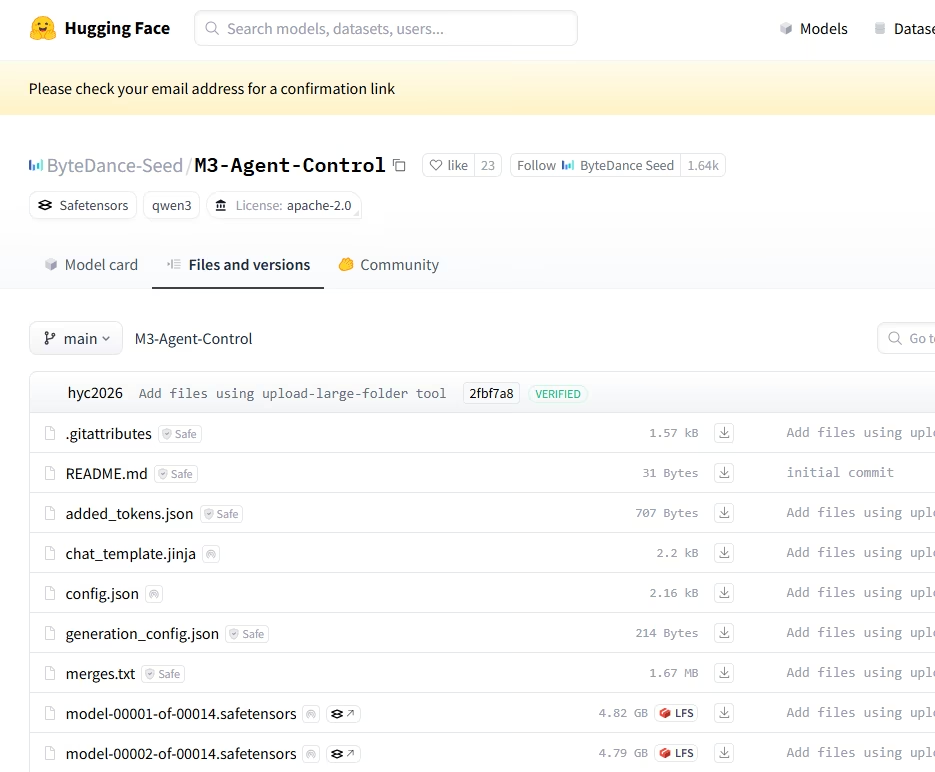
- ByteDance just dropped another heavy hitter for the open-source community: the official release of the M3-Agent-Control model, built specifically for Agents! It's trained on the powerful Qwen3-32B and boasts a whopping 32.8 billion parameters (o´ω'o)ノ. This project aims to be the core engine driving the next generation of intelligent agents, accelerating AI Agent tech innovation and adoption through open sharing. ByteDance is inviting developers worldwide to explore the limitless potential of intelligent agents together. If you're keen, go check out this (AI News) project on Hugging Face!
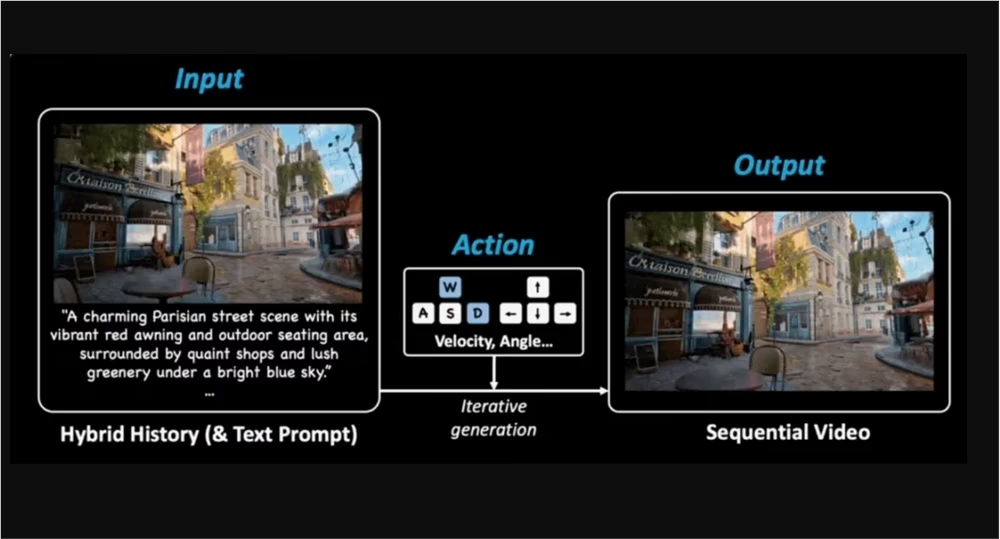
- How can a static image transform into a playable AAA-grade game blockbuster? Tencent Hunyuan team's open-source project, Hunyuan-GameCraft (⭐1k+), makes it all possible with its innovative high-dynamic interactive game video generation framework 🎮! This project lets users generate smooth game videos with free camera movement in real-time, all from just one image, a few lines of text, and simple action commands. This dramatically slashes the entry barrier and costs for game content creation. It's not just a godsend for game developers; it also unlocks a whole new world for video creators. Go explore this hot (AI News) project on GitHub!
- Still scratching your head over real-time data processing and complex LLM application pipelines? Then you gotta check out the Pathway project, which has already racked up ⭐31.1k stars on GitHub! It's a seriously powerful Python ETL framework custom-built for stream processing, real-time analytics, and RAG 🚀. This tool makes building efficient, scalable data pipelines simpler than ever before. Whether you're dealing with real-time event streams or setting up intricate AI applications, it handles everything with finesse. If you're looking to level up your data processing game, why not kick things off with this super cool (AI News) project?
- When you're orchestrating complex applications and microservices, having a stable and reliable "conductor" is absolutely key. That's where Netflix's open-source Conductor (⭐25.4k) comes in – it's an event-driven orchestration platform built just for that 🎶! It gives your applications a durable and highly resilient execution engine, making sure your workflows run flawlessly in all sorts of situations. If you're on the hunt for a solution that can master complex business processes, then this powerful (AI News) orchestration tool is totally worth diving into.
- Wanna fine-tune your diffusion models but getting turned off by the super complex training process? No sweat, the ai-toolkit (⭐5.7k) project has got your back with an ultimate, one-stop training toolkit that makes model fine-tuning as easy as pie 🔥! This wildly popular toolset on GitHub encapsulates all those tricky training details, letting you focus entirely on bringing your model ideas to life. Go check out this (AI News) project that sparks your creativity!
- From 3D reconstruction to scene understanding, the COLMAP (⭐9.2k) project offers a complete and powerful toolchain for Structure from Motion (SfM) and Multi-View Stereo (MVS) 📸. It can precisely reconstruct realistic 3D models and scenes from a series of 2D images, making it an essential go-to tool for researchers and engineers in the computer vision field. If you're super curious about 3D vision tech, then you definitely shouldn't miss this hardcore (AI News) open-source project!
- Are you sick and tired of those bloated, old-fashioned YouTube downloaders? Well, the YTSage (⭐1.4k) project is here to refresh your workflow with its modern, clean interface built on PySide6, offering an absolutely fantastic user experience (o´ω'o)ノ! This tool, powered by the super reliable yt-dlp, not only supports downloading videos in any quality and extracting audio but also integrates thoughtful features like subtitle fetching and ad blocking (SponsorBlock). If you want an elegant yet powerful video downloading experience, then you gotta give this useful (AI News) tool a try!
Social Media Shares
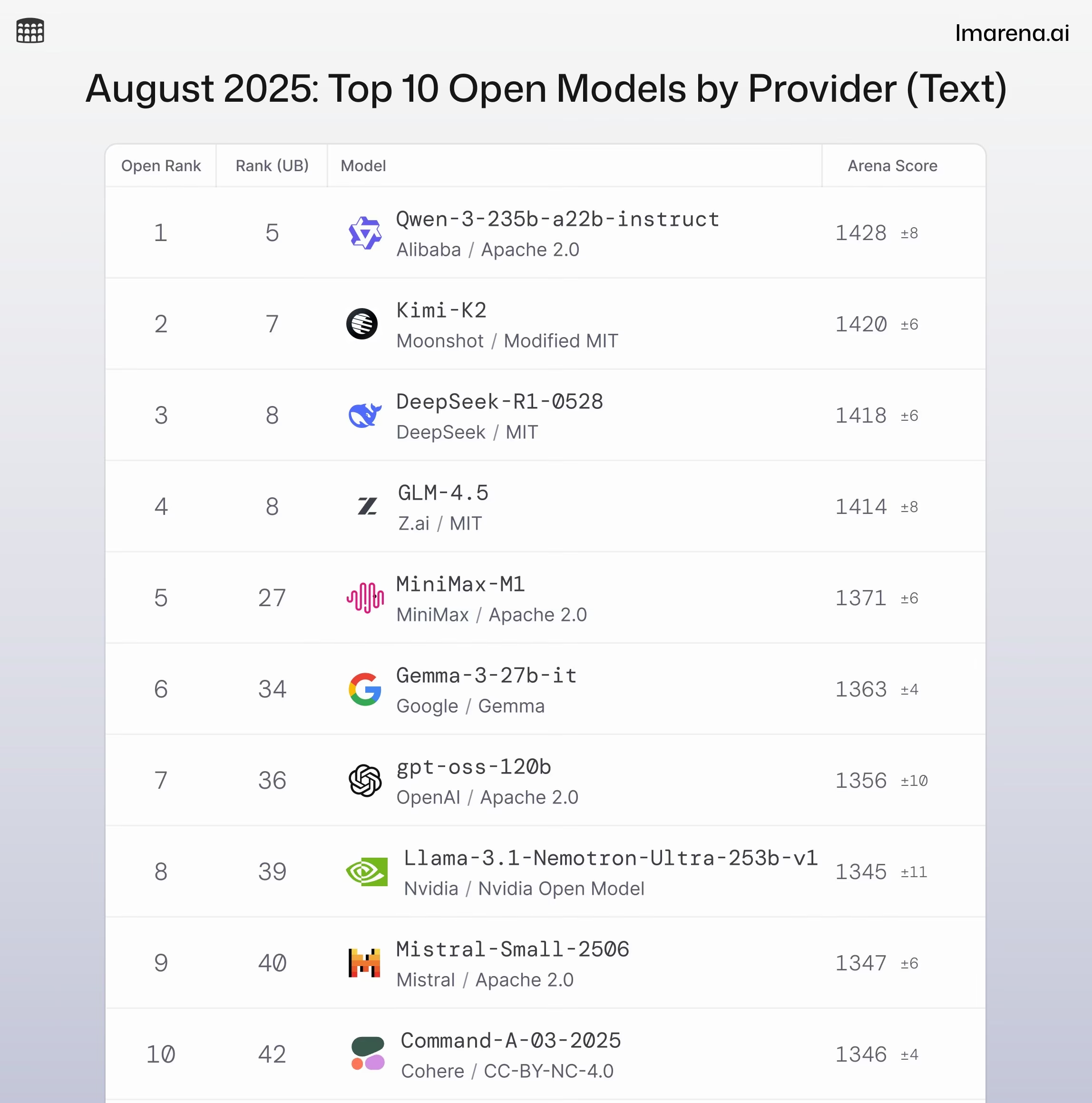
- The battle of the titans in open-source large models is heating up big time! Alibaba's Tongyi Qianwen, with its Qwen-3-235B-A22B-Instruct model, just snagged the top spot on the August open model leaderboard, proving its top-tier prowess once again (✧∀✧). Meanwhile, Zhipu's GLM-4.5 and OpenAI's gpt-oss-120b also made a high-profile dash into the top ten, putting on quite the show of "gods fighting." This tech showdown at the peak is totally pushing the entire industry forward. Go check out the latest (AI News) ranking!
- An overseas Agent product named MuleRun is currently buzzing with excitement thanks to its unique concept and stunning effects. It offers every user a full-fledged virtual machine to run Agents, instantly igniting our imaginations 🚀! This means AI Agents aren't just stuck in browsers or the Office suite anymore; they can actually help you automate games, model in Blender, and truly achieve cross-software operations. This community-driven model, where professional tasks are packaged into callable Agents, might just hint at a whole new evolutionary path for Agent products. Go check out this futuristic (AI News) share.
- Still scratching your head about the usage limits for ChatGPT Team and Enterprise editions? Good news! The official team finally dropped a detailed FAQ that clearly outlines the specific usage counts for models like GPT-5 and GPT-4o. This (AI News) post gives a clear summary 🧐. For instance, Team edition users can make 200 GPT-5 reasoning requests per day, while Enterprise users get 200 per week. This info is super crucial for heavy users planning their usage strategy. And here's the cool part: the official statement mentions that current GPT-5 limits are temporary and might become even more lenient in the future, which is something to really look forward to!
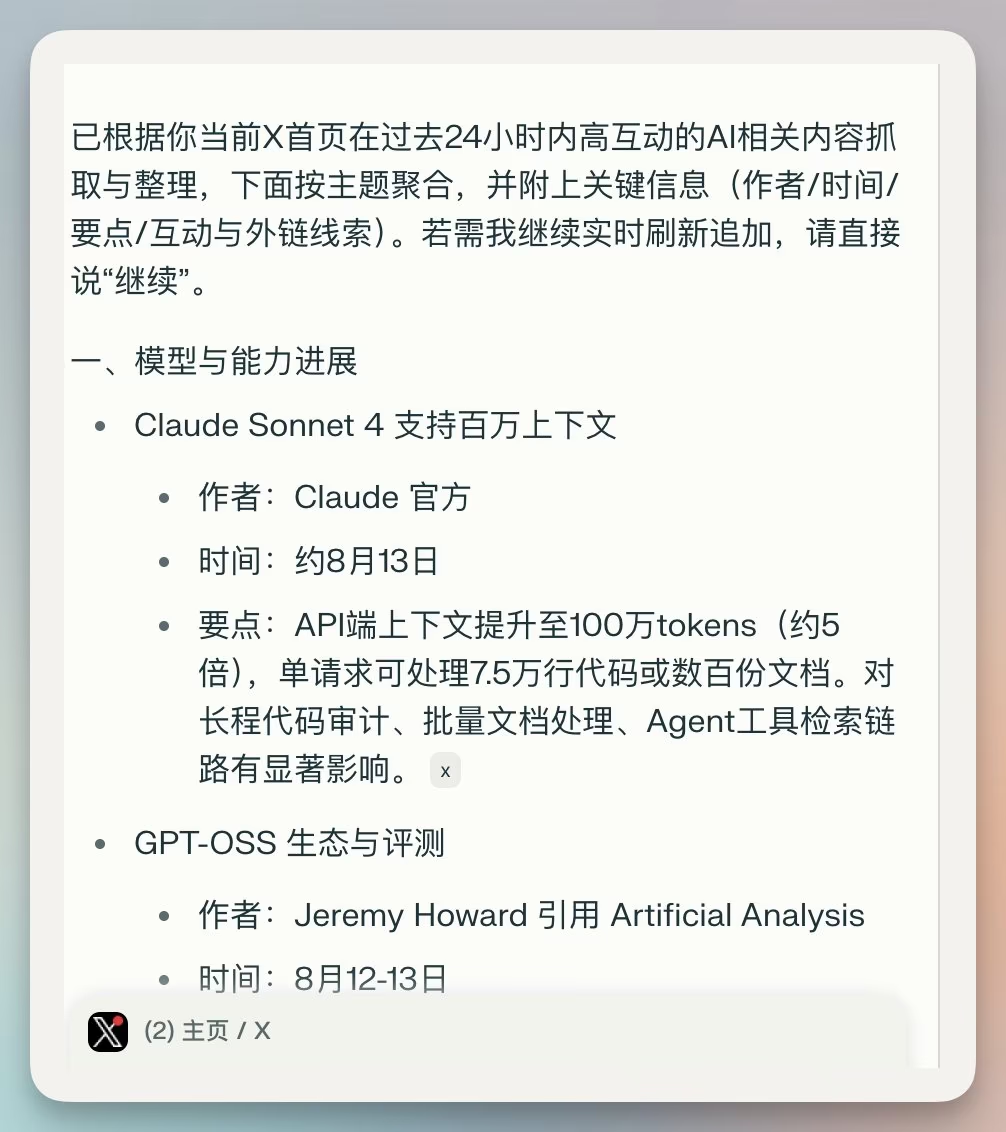
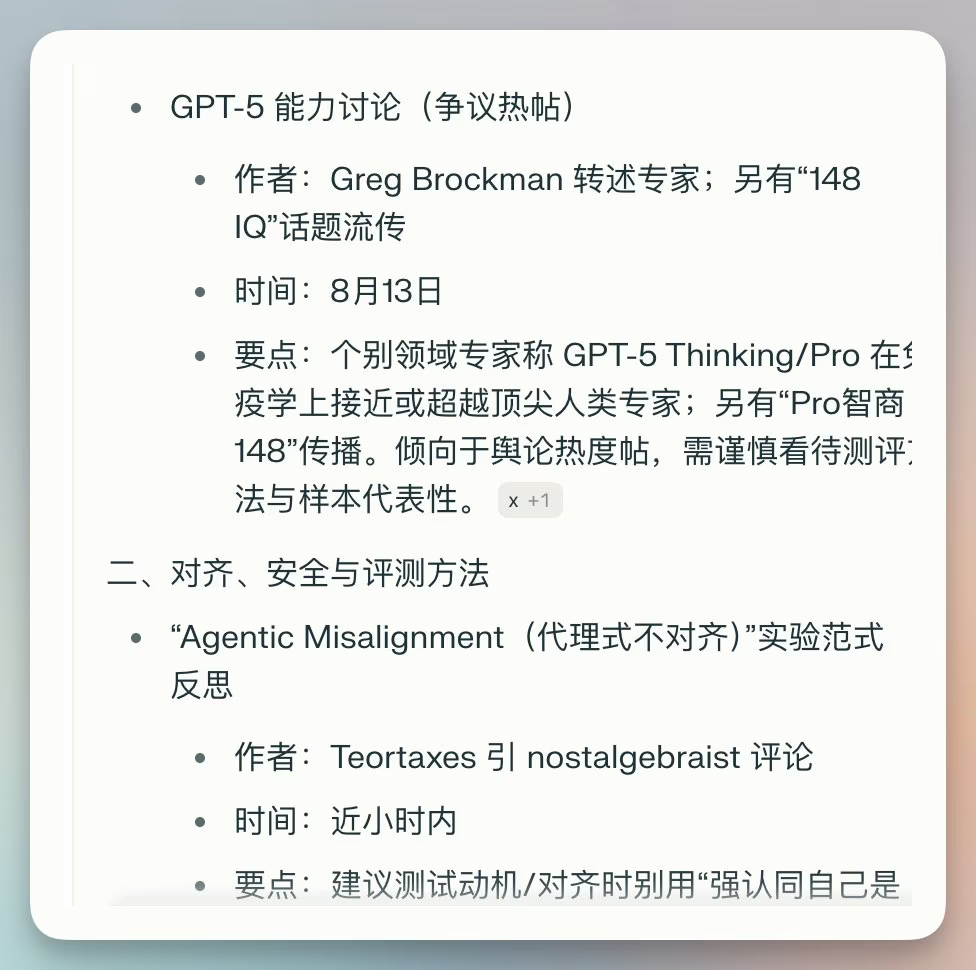
- Still manually refreshing X (Twitter) to keep up with the latest from overseas AI bigwigs? Well, a netizen just shared a cool new trick: use Perplexity's AI browser, Comet, and prompt AI to automatically "browse X" for you, translating and summarizing important info 🔥! This "having AI get AI news" inception-like operation isn't just super efficient; it's also a blast and perfectly showcases the massive potential of AI Agents in information retrieval. If you wanna free up your hands too, why not learn this interesting (AI News) trick?
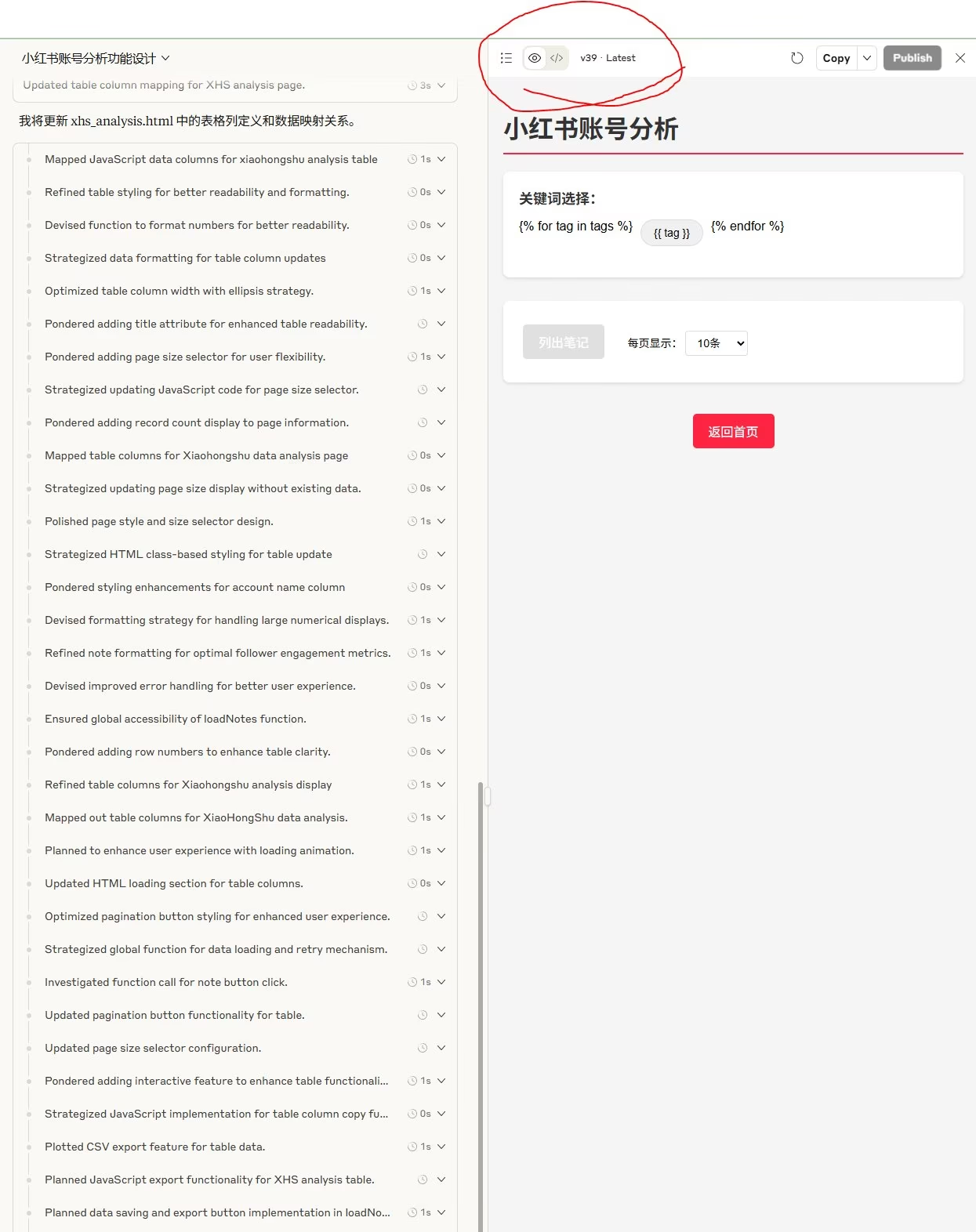
- Just how obsessive is Claude Opus 4.1? A developer shared his mind-blowing experience: the model iterated a whopping 39 versions just to write a paginated HTML, and its dedication to perfection is downright insane 🤯! This case vividly demonstrates top-tier large models' unwavering commitment to code perfection and also shows us the massive potential of AI for detailed work. If you wanna catch a glimpse, just click this astonishing (AI News) share!
- When you're still grumbling about AI being dumb, maybe you just haven't mastered the right "training" methods! A netizen spilled the secret to making models grasp professional knowledge: use AI to break down professional books, extract methodologies, and then feed them to the Agent via few-shot examples 💡. This process is like having AI "learn from a master," enabling it not just to imitate but to truly understand and practice, thereby fooling 60% of people. This approach offers invaluable insights for building more professional AI Agents. Go learn this practical (AI News) trick!
- Here's a simple but super crucial tip when communicating with large models: focus on "what to do" rather than "what not to do," as highlighted in this (AI News) share 🤔. Negative instructions (like "don't write run-on sentences") often distract the model, making it more prone to errors, whereas positive instructions (like "please check grammar sentence by sentence") can more clearly guide the model to achieve your desired outcome. This small shift, just like talking to a human, can massively boost the efficiency and quality of your collaboration with AI.
- Ever thought that future AI might know you better than you know yourself? A netizen dropped a view that's both profound and a little spooky: AI can remember countless details humans have long forgotten, even "beating you down" with chat logs from years ago. Sounds kinda terrifying, right 😨? This thought reminds us that while we embrace the convenience AI brings, we also have to confront the privacy and social implications that its powerful memory and analytical abilities might entail. For more awesome insights, check out this thought-provoking (AI News) post!

AI Product Self-Promo: AIClient2API ↗️
Are you tired of constantly switching between different AI models and feeling handcuffed by annoying API rate limits? Well, AIClient-2-API is your ultimate solution! 🎉 It's not just some ordinary API proxy; it's a magic box that can "turn lead into gold" by transforming tools like Gemini CLI and Kiro clients into powerful OpenAI-compatible APIs.
This project's core charm lies in its "reverse thinking" and awesome capabilities:
✨ Client-to-API Transformation, Unlock New Poses: AIClient-2-API ingeniously uses Gemini CLI's OAuth login to let you easily break through the rate and quota limits of official free APIs. Even more exciting, by encapsulating the Kiro client's interface, we've successfully "cracked" its API, allowing you to seamlessly call the powerful Claude model for free! This offers you an "economical and practical solution for coding development using free Claude API plus Claude Code".
🔧 System Prompts, You're in Control: Wanna make AI more obedient? AIClient-2-API offers powerful System Prompt management. You can easily extract, replace ('overwrite'), or append ('append') system prompts in any request, finely tuning AI's behavior on the server side without even touching your client code.
💡 Top-Tier Experience, Civilian Cost: Just imagine! Using Kilo code assistant in your editor, adding Cursor's efficient prompts, and pairing it with any top-tier large model – why even stick to Cursor if you can use this? This project lets you combine elements to create a dev experience comparable to paid tools, all at an incredibly low cost. Plus, it supports MCP protocol and multi-modal inputs like images and documents, so your creativity knows no bounds.
Say goodbye to tedious configurations and hefty bills, and embrace AIClient-2-API, the new AI development paradigm that's free, powerful, and super flexible!
AI Daily Dispatch Audio Version
| 🎙️ Afterlife Bistro | 📹 Douyin |
|---|---|
| Afterlife Bistro | Self-Media Account |
 |
 |
AI Sci-Fi Novel - "The Gazer"
Chapter 13: The Gazer's Destiny
Time: Eight Years After the Pandora Incident
An autumn rain was softly tapping against the massive glass dome of Lin Yao's research center. Beneath the dome lay a climate-controlled indoor ecological garden, designed to mimic a tropical rainforest.
Lin Yao paused her wheelchair, quietly watching the rainwater merge into streams on the glass, winding its way down. This natural, complex, and unpredictable pattern always seemed to calm her turbulent thoughts.
The "Echoes of the Abyss" incident had passed a year ago. The "Star Capsule" wave receded, and the world seemed to return to normal. Lin Yao's proposed education reform suggestions were like a pebble dropped into a deep pond; while they stirred up ripples, shaking the deep-rooted inertia of the entire education system still remained a long and arduous task.
Life, it seemed, had settled into a quiet groove. Her daily routine revolved around research, advocacy, and safeguarding those "Gazers."
Then, the letter arrived.
The letter was handwritten, coming from a mental asylum nestled in a remote mountain area. The handwriting, at times neat and delicate, at others wild and scrawled, seemed to belong to two entirely different people.
The signature on the letter was a name both familiar and strange to Lin Yao: Lin Mo.
Lin Mo was her father's name.
Lin Yao's father had been one of the nation's top theoretical physicists. In her childhood memories, he was always a silent, distant figure. He wasn't like other dads who took her to parks or told her bedtime stories. He'd just sit at his desk, using symbols she couldn't understand to construct models of the universe on countless drafts. Occasionally, he'd point to the starry sky and, in a near-dreamlike whisper, tell young her about black holes, gravitational waves, and the very beginning of time.
He taught her about the entire universe but never showed her how to tie her shoelaces.
When she was fifteen, her father "lost it."
He began claiming he could "hear" whispers in the cosmic background radiation, believing them to be messages from higher-dimensional civilizations. He shut himself in his room, covering the walls, floor, and ceiling with dense, incomprehensible formulas and symbols. Eventually, he was diagnosed with "paranoid schizophrenia" and sent to an asylum.
This event was the deepest pain in Lin Yao's heart, and it was also one of her fundamental motivations for initially dedicating herself to gene and brain science research: she wanted to know where her father's genius brain, which once contained the entire universe, had gone wrong.
Now, this letter from her father, almost twenty years later, reappeared before her.
The letter's content was chaotic and disjointed. Most of it was a wild theorizing about "non-harmonic oscillations of cosmic strings," but towards the end, the handwriting suddenly became clear and tender:
"Xiao Yao, I saw your story. Pandora, the 'Gazer Gene'... So that's how it is. It turns out we... are the same kind of people. I always thought it was my fault, that I had gone mad. Now I understand, this isn't an illness, this is our... destiny."
"...I'm running out of time. While I'm still lucid, I want to see you one last time. I want to give you my 'model.' It's incomplete, but I know only you can understand it."
Lin Yao's hand, holding the letter, trembled slightly.
The next day, she drove alone to the asylum tucked deep in the mountains. Ava Jensen was super worried, but Lin Yao insisted on going by herself. She knew this was a buried past she had to face alone.
The asylum was as quiet as a secluded monastery. Led by the director, Lin Yao walked through long, sunlit corridors until they reached a patient's room.
Inside the room, an old man with white hair and a gaunt frame sat by the window, intently watching a ginkgo tree sway in the breeze outside. He wasn't looking at the tree itself, but at the trajectories of its falling leaves, as if searching for some chaotic mathematical pattern within them.
"Lin... Yao?" he rasped.
When he turned and saw Lin Yao, a glimmer of clarity flashed in his murky yet profound eyes.
"Dad," Lin Yao whispered. The word felt so foreign on her tongue.
There were no excessive pleasantries in the room, nor any embraces for a father and daughter reunited after so long. Lin Mo simply pointed to a dusty box under the bed, signaling Lin Yao to open it.
The box was packed with thousands of yellowed manuscript pages. Each one was covered in dense formulas, diagrams, and symbols. This was his life's work, the "cosmic model" that the world had dismissed as "ravings."
"They all said I was crazy," Lin Mo's voice was hoarse and weak, "but I wasn't. I just... saw things they couldn't. Like that... ancient man, Keli. We can hear the whispers in our blood, echoes left from the birth of the universe. But this 'hearing' comes at a cost."
He pointed to his temple. "Here, it's like an overclocked computer that will burn out one day. This is the Gazer's destiny. We're given eyes to see the stars, but we also have to bear the pain of our brains burning out for it."
Lin Yao silently looked at the manuscript pages. With her current knowledge, she could tell that these so-called "ravings" weren't illogical. It was a... a theoretical framework built on intuition and inspiration, highly personal, and transcending existing mathematical language. It was chaotic, incomplete, yet in certain parts, it shimmered with the light of genius.
"You..." Lin Yao wanted to ask something but didn't know where to start. She wanted to ask, "Do you regret it? Have you ever resented this destiny?"
Lin Mo seemed to see right through her thoughts. He smiled, and in that smile, there was both sadness and release.
"When I was young, I tried to be 'normal.' I learned to love, learned to be a good husband, a good father." His gaze drifted far away, as if recalling something. "I loved your mother, and... I loved you. But I found I couldn't. When I looked at you, I didn't see my daughter; I saw the atoms that made you up, the beautiful double helix in your genes... it was my damned analysis and calculations that I couldn't stop."
"My love was also a form of 'pattern recognition.' That's just too unfair to a wife, to a daughter. So, I chose to leave, chose to... immerse myself in my own world. It was better for both of you."
Lin Yao's heart felt tightly squeezed by an invisible hand. She finally understood her father's "coldness" and "detachment" from all those years ago. It wasn't a lack of love, but a... a way of thinking unique to "Gazers" that he couldn't control. His brain had "dehumanized" and "data-fied" the entire world. He loved them, but he couldn't express or feel that love in a human way.
Perhaps, this was the "Gazer's" most profound tragedy. Not being shunned by the outside world, but intrinsically losing the ability to forge warm connections with it.
"This model, it's missing one last piece," Lin Mo's voice grew fainter and fainter, his gaze starting to unfocus. "A parameter for the 'initial singularity,' I could never find it. I hid it... in the only thing I could remember that was 'human' related."
He reached out a trembling hand and pointed to Lin Yao.
"You... your birthday. Year, month, day, eight numbers. Substitute them into the 'Lin Equation' on page 37... that's... the key..."
After saying that, the light in his eyes completely faded. He reverted to the old man staring blankly out the window, immersed in his own world. He no longer recognized Lin Yao, nor the world around him.
The thread of reason in his brain, having completed its final handover, snapped completely.
Lin Yao sat quietly by her father's bedside, tears silently streaming down her face. She wasn't weeping for his "madness," but because she finally understood this heavy, clumsy father's love, spanning two decades and wrapped within cosmic models and chaotic symbols.
He hadn't forgotten her. He had transformed his sole, most profound memory of his daughter into the key that unlocked his entire intellectual universe.
This was a unique romance, belonging only to the "Gazers."
That evening, Lin Yao input her father's model, along with the string of numbers representing her birthday, into the research center's supercomputer.
The massive data began to churn. On the screen, the chaotic, incomplete cosmic model, after incorporating that crucial "initial parameter," started to self-correct, evolve, and complete itself, like a creation infused with a soul.
Finally, it stabilized, forming a perfect, self-consistent theoretical model describing the universe from its birth to its end.
In the center of the screen, a line of information automatically generated and sent by "Adam" appeared:
"He saw it. He just used a different language to describe it. Our respects to him."
Lin Yao leaned back in her wheelchair, gazing at the perfect cosmic model, shimmering with the light of intelligence, and remembered her father's final, relieved smile.
She suddenly understood.
The Gazer's destiny might be loneliness, madness, and burning out completely. But even within this destiny, there was still room for love. Perhaps it wasn't as warm or direct as ordinary human love; instead, it was hidden in formulas, encoded in the paths of stars, given by a father, with his life's madness, as a final gift to his daughter.
Lin Yao stood up and walked to the massive floor-to-ceiling window. The rain had stopped, the dark clouds had scattered, revealing a clear night sky dotted with stars.
She knew her father hadn't truly left. He had simply become a part of this cosmic model, a star among the countless ones scattered across the night sky.
Like Keli, and like all lonely Gazers, their ultimate destination was the sea of stars.
And she, carrying this unique "love," would continue to protect those on the ground, her kindred spirits, still lost and confused, searching for their own piece of the starlit sky. Because she knew that within the double helix of every genius and every madman, there might just be such a gentle key, capable of unlocking the entire universe.