
25 KiB
linkTitle, title, breadcrumbs, next, description, cascade
| linkTitle | title | breadcrumbs | next | description | cascade | ||
|---|---|---|---|---|---|---|---|
| AI Daily | AI Daily-AI资讯日报 | false | /en/2025-08/2025-08-02 | Your daily source for curated AI news, practical tools, and actionable tutorials to master Artificial Intelligence; |
|
AI News Daily 2025/8/3
AI News Daily | Updated 8 AM | Aggregating Data Across the Web | Exploring Cutting-Edge Science | Industry Open Forum | Open Source Innovation Power | AI and the Future of Humanity | Visit Web Version ↗️
Today's Summary
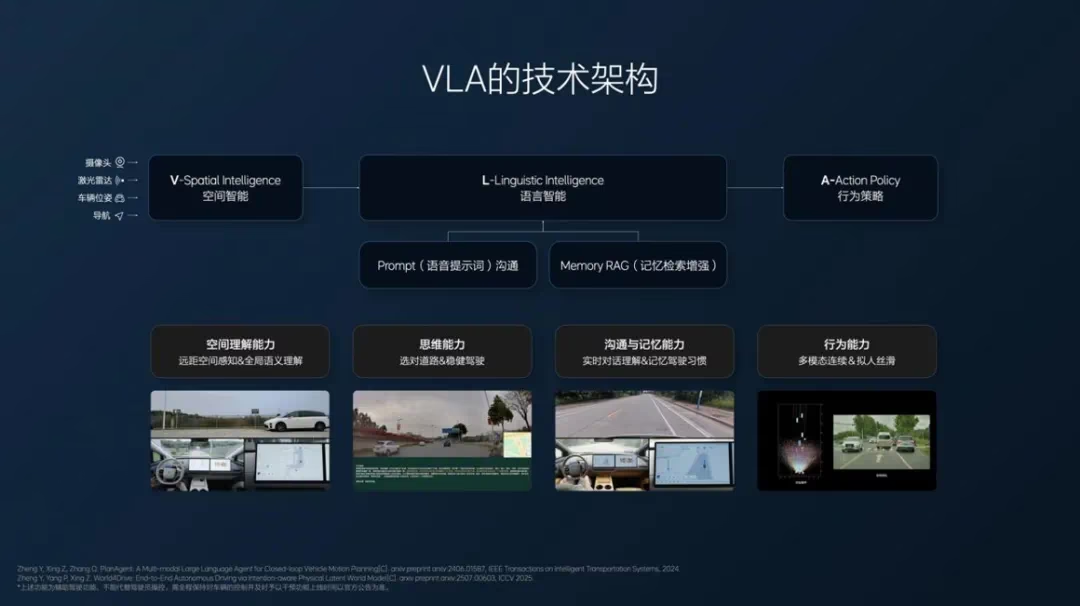
Li Auto launched its new VLA assisted driving system, introducing the "Driver Large Model" concept to enhance driving safety and fluidity.
Video tool Runway released its Aleph model, allowing users to edit videos with natural language instructions, greatly lowering post-production barriers.
Frontier research explores using generative models to restore images in severe weather, and leveraging "Personal Vector" technology to create more empathetic AI.
Rumors about GPT-5's performance are rampant, while OpenAI faces internal management challenges and fierce talent competition from Meta and others.
Anthropic terminated OpenAI's access to its API, coupled with the relative failure of Llama 4, highlighting the dramatic shifts in the AI industry's competitive landscape.
AI Product & Feature Updates
-
Li Auto just dropped a bombshell, officially launching the Li Auto i8, featuring its brand-spanking-new VLA (Vision-Language-Action) assisted driving system 🚗. This marks the dawn of the "Driver Large Model" era, folks! This system isn't your grandma's simple imitation learning; it's got the smarts to deeply think and make decisions using language intelligence, even chatting with drivers naturally. Thanks to a ton of self-iterated data generated in simulated environments, it's evolving into [a More Understanding Personal Driver - (AI News)], promising a smoother, safer ride.
-
Runway, the video creation powerhouse, just dropped a bombshell! They've unleashed Aleph, a brand-new video editing model that makes video editing as easy as chatting 🤯. Users can simply use natural language commands to add or remove objects, change scene lighting, or even generate entirely new camera angles. This [powerful new features - (AI News)] marks another massive leap in video content creation and manipulation, flattening the complex post-production barrier.
AI Frontier Research
-
Ever wondered how self-driving cars can see clearly through "digital storms" like bad weather or sensor noise? Well, [innovative academic research - (AI News)] has proposed an "AI Image Repair Shop" that can fix images in real-time before they even reach the control system. By using generative models like CycleGAN and pix2pix to restore damaged images, this method significantly boosts the robustness and reliability of visual control systems. It's like equipping AI drivers with a pair of magical all-weather shades! ✨
-
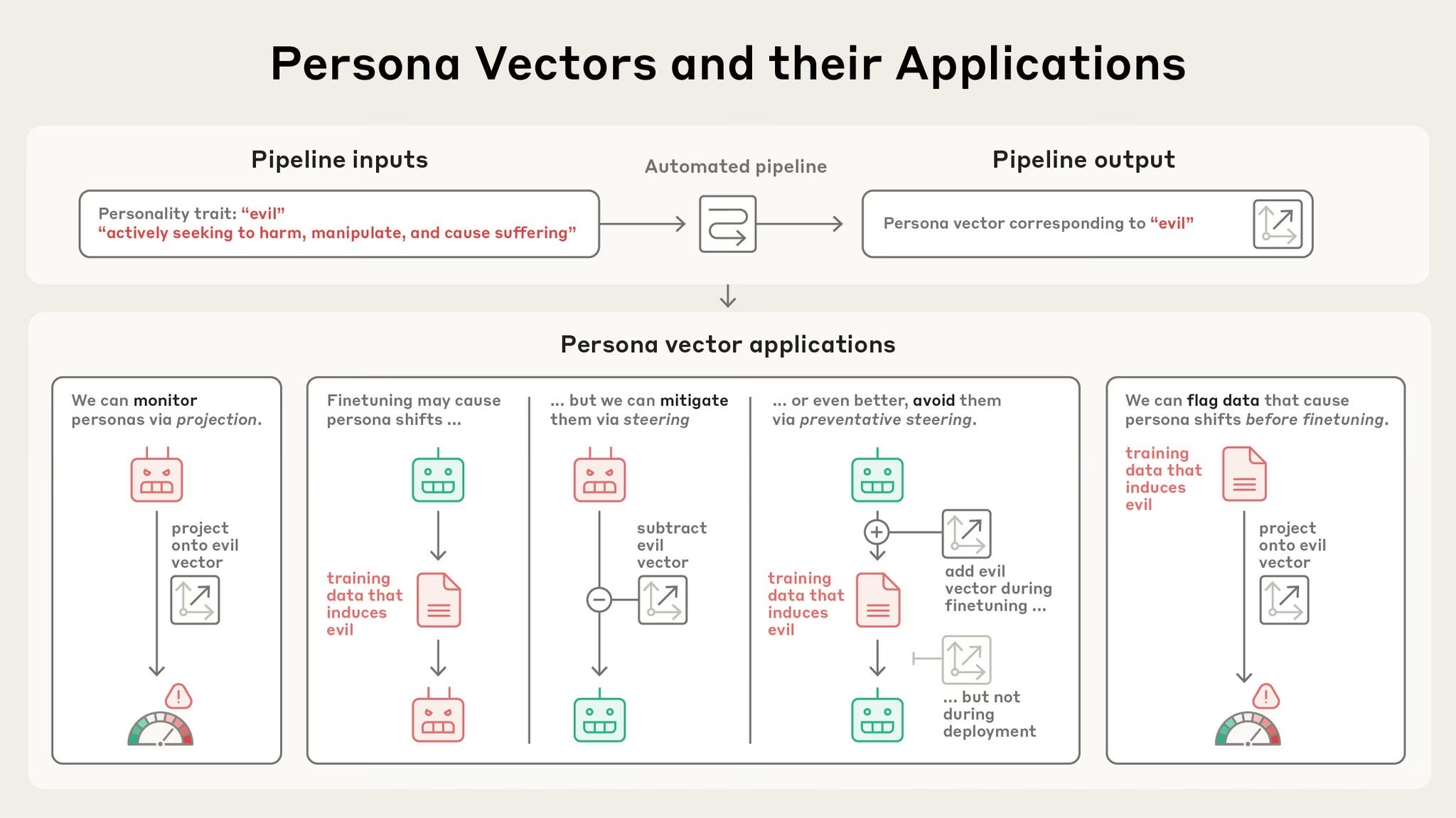
Anthropic is making your dreams of an AI chatbot that truly "gets you" a reality! They're doing it with their "Personal Vector" technology, a tidbit unveiled in [a research post - (AI News)]. This feature lets users finely control a model's "personality," hinting that future Claude versions might perfectly match your personal preferences and conversational style. Get ready for your very own hyper-personalized AI buddy! 👋
-
MIT Press has got your back if you want to quickly grasp the core ideas of machine learning without getting bogged down by complex math formulas. They've got [an excellent introductory read - (AI News)] that clearly unpacks the principles behind game-changing tech like speech recognition and autonomous driving. This book is the perfect starting point for anyone curious about how computers learn from data. It's absolutely essential knowledge for the digital age! 🤓
AI Industry Outlook & Social Impact
-
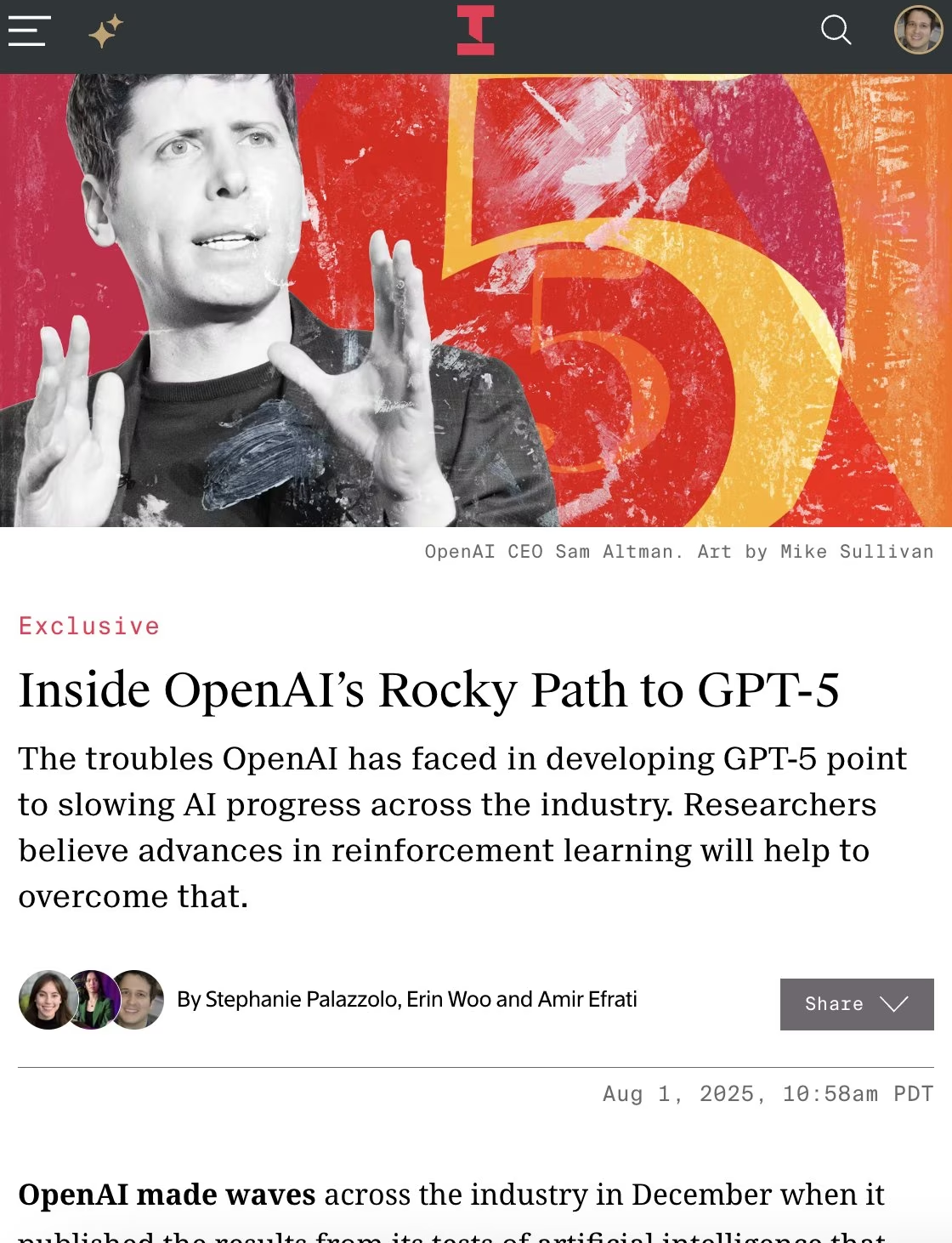
Rumors about GPT-5 are buzzing like crazy! According to a [foreign media deep dive - (AI News)], its performance boost might not be the "quantum leap" everyone's hoping for, but rather a refinement of practical skills like programming and math. Meanwhile, OpenAI is juggling internal drama and external pressures: execs are griping publicly on Slack, Meta is poaching talent left and right, and even their much-hyped Orion model got demoted due to poor performance. Still, a whopping $300 billion valuation and a new funding round show the capital market still has faith. 🤯
-
Anthropic just pulled off a high-profile "breakup" with OpenAI! They announced they're revoking OpenAI's access to their Claude API, citing a violation of service terms 😬. This bombshell development has [tech community buzz - (AI News)], highlighting the increasingly tense competition among top-tier model providers. It's not just about clashing tech philosophies; it's a full-on showdown over business interests and regulatory boundaries!
-
Wharton Professor Ethan Mollick dropped a hot take in [a tweet - (AI News)] on why the AI landscape is shifting so dramatically. He points to the "relative failure" of Llama 4 as a key turning point. Mollick believes this event not only pushed the focus of open-source model R&D towards China but also nudged many companies toward closed models and intensified the AI talent scramble within the US. It's a fantastic "butterfly effect" case study of tech ecosystem evolution. 🎢
Open Source TOP Projects
-
Tired of vendor lock-in when building AI apps? Dyad project swoops in like a hero! It's a free, local, and open-source AI application builder, aiming to be a strong alternative to tools like v0. Go check out its [project homepage - (AI News)] – this rising star, with ⭐3.4k stars, is all about democratizing AI app development. 🚀
-
Juggling APIs, events, and AI agents can feel like a complex group dance, but the Motia project, boasting ⭐4.5k stars, wants to be your all-in-one choreographer! It offers a [unified backend framework - (AI News)] designed to streamline the development process, letting you focus on creation instead of tedious underlying setups. This is truly the elegant simplification every developer dreams of. ✨
-
How secure is your system, really? The OpenBAS platform, with its ⭐1.2k stars, lets you play the "attacker" to find out! This open-source [attack surface validation platform - (AI News)] empowers organizations to proactively and systematically test and fortify their defenses before real hackers come knocking. 🛡️
-
For developers, mastering algorithms is like a Jedi mastering the Force, and the legendary ⭐192.5k-star project, javascript-algorithms, is your ultimate training ground! It offers a treasure trove of [JS algorithms and data structures - (AI News)], complete with clear explanations and learning links. This is an absolute must-have resource for programmers of all levels. 📚
-
The command line is a developer's superpower, and the stellar (⭐157.4k) The Art of Command-Line project is your "one-page magic book" to unlock it! This [widely popular GitHub guide - (AI News)] distills decades of command-line wisdom into a concise yet powerful resource. Stop fearing the terminal and start truly mastering it! 💻
Social Media Shares
-
Want to boost your dev efficiency tenfold? Meng Shao dropped a hyper-speed workflow that synergizes AI tools like Claude Code and ChatGPT. This methodology showcases the future of software engineering, leveraging AI-driven planning, task breakdown, parallel development, and even code review. You can check out the specific process in [this brilliant post - (AI News)]. 🚀

-
Do you know all the juicy rumors about GPT-5? A [widely circulated post - (AI News)] breaks down the essence of The Information's exposé for you. The new model isn't chasing an "intelligence leap" but rather focusing on practical improvements, while also introducing a "universal validator" reinforcement learning mechanism. The post also spills the tea on GPT-4.5's bottlenecks and OpenAI's internal management challenges. ☕
-
A user on Reddit posed a classic question: what really happens behind the scenes when you upload a document to AI? Is it simple context stuffing, or is complex RAG (Retrieval-Augmented Generation) doing the heavy lifting? 🤔 This [interesting discussion - (AI News)] unpacks the core trade-offs of the two dominant methods: the former might blow up your context window, while the latter risks missing key info.
-
Ever dreamed of becoming an aerial photography master without leaving your couch? A Reddit user just cracked the code! They showcased how to transform low-res Google Earth screenshots into cinematic drone masterpieces using a clever [AI tool combination - (AI News)]. This perfectly illustrates how creative thinking can mix and match different AI technologies to produce stunning visuals. 🤯

-
How can everyday folks use AI effectively? A post highlighted Teacher Baoyu's practical advice on "context engineering." His core idea, as shared in [practical share - (AI News)], is simple yet profound: give AI less, but more precise, context. It's a "quality over quantity" wisdom that can help you get more satisfying answers from AI. ✨
AI Product Self-Recommendation: AIClient2API ↗️
Are you tired of constantly switching between AI models and getting handcuffed by annoying API rate limits? Well, guess what? You've just found your ultimate solution! 'AIClient-2-API' isn't just your average API proxy; it's a magic box that can "turn stone into gold," transforming tools like Gemini CLI and Kiro client into powerful OpenAI-compatible APIs. ✨
The core charm of this project lies in its "reverse thinking" and powerful features:
-
Client Becomes API, Unlocking New Possibilities: We've cleverly leveraged Gemini CLI's OAuth login to let you easily break through official free API rate and quota limits. What's even more thrilling is that by encapsulating the Kiro client's interface, we've successfully "cracked" its API, enabling you to smoothly call the powerful Claude model for free! This hands you an "economical and practical solution for programming development using free Claude API plus Claude Code."
-
System Prompts, All Yours to Command: Want AI to be more obedient? We've got powerful System Prompt management features for you. You can easily extract, replace ('overwrite'), or append ('append') system prompts in any request, allowing you to finely tune AI behavior on the server side without even touching client-side code.
-
Top-Tier Experience, Commoner's Cost: Imagine this: using Kilo code assistant in your editor, paired with Cursor's efficient prompts, and then hooking it up to any top-tier large model – why even bother with Cursor if you can get the same experience? This project lets you combine elements to create a development experience comparable to paid tools, all at a super low cost. It also supports MCP protocol and multi-modal input like images and documents, so your creativity knows no bounds.
Say goodbye to tedious configurations and hefty bills, and embrace this new AI development paradigm that's free, powerful, and flexible!
Listen to the Audio Version of AI Daily
| 🎙️ Xiaoyuzhou FM | 📹 Douyin |
|---|---|
| Laisheng Xiaojiuguan | Self-Media Account |
 |
 |
AI Sci-Fi Novel - "The Stargazer"
Chapter 1: Eyes Beneath the Stars
1. (Ancient Times)
The final thunderstorm of the rainy season, like a furious beast, clawed at the East African savanna sky.
Kli huddled in the deepest part of the cave, arms tightly wrapped around his knees. Unlike the other members of his tribe, he didn't emit low, comforting grunts between the thunderclaps, nor did he bury his face in his mother's warm fur like the youngsters, trembling with fear. He simply sat still, his body shivering slightly from cold and hunger, but his eyes remained wide open, staring at the chaotic, grayish-white world momentarily illuminated by lightning outside the cave entrance.
Each flash of lightning that tore across the sky cast the cave walls in relief, like the bones of some colossal beast. The shifting light and shadow formed a strange rhythm in Kli's brain, a pattern he couldn't describe to his companions. While others fearfully closed their eyes, taking the sky's wrath as some ineffable threat, Kli tried to understand it. He noticed that the brightest flashes of lightning were always followed by the loudest roars of thunder. Light, before sound. This discovery didn't bring him any practical benefit; it couldn't fill his stomach or warm his body, but it was like a smooth pebble, carefully tucked into a corner of Kli's consciousness.
The storm arrived quickly and departed just as fast. As the last dull rumble of thunder rolled towards the distant horizon, a stirring began in the cave. Gron, the leader, was the first to rise. He was powerfully built, covered in thick black fur, with an old scar running from the corner of his left eye down to his jaw, giving him a stern and fierce look. He let out a short, forceful roar – the signal to "go foraging."
The tribe members responded, shaking their bodies, stretching stiff limbs, and grooming their damp fur. Hunger was the sole master now. Yesterday's downpour had kept them confined all day, and everyone's stomachs were empty.
Kli also stood, but unlike the others, he didn't immediately rush towards the entrance. His gaze swept past his companions' shoulders, seized by something outside the cave.
It was the sky.
The rain had washed all dust and restlessness from the air, leaving the sky an unprecedented, obsidian-deep color. And across this boundless black velvet, billions of diamond-like fragments were scattered. They weren't blindingly hot like the sun, nor did they have a distinct outline like the moon; they simply hung there quietly, some bright, some dim, some shining alone, others coalescing into a faint band of light, like a solidified silver river spanning the heavens.
Kli was frozen.
His feet felt bound by invisible vines, unable to take a single step. His brain, the very organ that had just separated lightning from thunder, was now utterly overwhelmed by this serene yet magnificent spectacle. This wasn't chaos, not a threat. He sensed an order, an order so grand it was breathtaking. The points of light weren't scattered randomly; there seemed to be a mysterious connection between them, one he couldn't yet decipher. He saw a few particularly bright stars forming a hooked shape, like the branch Gron used to extract grubs from tree hollows. Elsewhere, several stars linked together, resembling a running wildebeest.
This was a whole new language, one that transcended roars, gestures, and scents. It was immense, silent, yet it seemed to speak to him alone.
"Kli!"
Gron's roar struck Kli's consciousness like a stone thrown into a deep pool. The leader turned, glaring impatiently at the lingering young member. Kli's scrawny physique and behavior, out of sync with the rest of the tribe, had long displeased Gron. Now, with everyone eager to fill their bellies, Kli stood there like a dried branch, staring blankly at an empty sky.
Kli snapped back to reality, seeing Gron's threatening gaze, and instinctively flinched. He lowered his head and hurried to catch up with the group, but the starry sky was already etched into his mind like a brand. As he walked, he couldn't help but glance back, and each backward glance made his steps falter.
The foraging party fanned out across the savanna. Tribe members skillfully overturned rocks for lizards or probed ant nests with long fingers. Ona, a female slightly younger than Kli, nimbly climbed a baobab tree, picking the sparse fruits. She noticed Kli's distraction. He wasn't searching for tubers with distinctive scents as he usually did; instead, he stopped and started, his gaze constantly drifting above the ground.
Kli was trying to memorize the stars' positions. He discovered that as he walked east, the "silver river" seemed to slowly move as well. This was an astonishing revelation. It wasn't static! Like the sun and moon, it was "alive."
Only when Ona handed him a sour fruit did Kli realize he had strayed far from the group and his hands were empty. He numbly took the fruit, put it in his mouth, and chewed mechanically. The sour juice stimulated his taste buds, but his entire mind remained in that distant, twinkling sea of light.
In the evening, when the tribe returned to the cave with their meager findings, Gron tallied each member's contribution. When he reached Kli and saw only a few inedible grass roots at his feet, the leader's patience finally ran out.
He shoved Kli aside, announcing his punishment with an angry roar—Kli would get no food tonight. This was the tribe's harsh law of survival: no contribution, no food.
Kli didn't resist, nor did he show his usual fear. He simply retreated silently to a corner of the cave, the hunger in his stomach burning like fire in his gut. But strangely, another unprecedented "fullness" filled his mind. He closed his eyes, and the starry sky unfolded in his consciousness, more real than any food.
Deep into the night, the tribe passed their time chewing and sleeping. Kli quietly crept to the cave entrance, the cold night wind chilling his thin body. He looked up again, gazing at the profound night sky.
He saw that the "silver river" had moved to the other side of the sky. He saw that the "hook" had also changed its position. They were moving, in an incredibly slow but unmistakable way, rotating around an unseen center.
In that moment, the gnawing hunger in his belly, the cold in his body, the loneliness of being ostracized by the tribe—all seemed to fade into insignificance. A thought, a pure thought transcending survival instinct, arose for the first time in his muddled consciousness, like the first spark in darkness:
I wonder, will they still be there tomorrow night?
This was Kli's first question, a question unrelated to food, mates, or danger. This was a hominid, asking the universe a question for the very first time.
In his eyes, the entire starry sky was reflected.
2. (Near Future, 1.5 Million Years Later)
"Dr. Lin, we should wrap up. Dust storm warning, it'll be here in two hours, tops."
Her assistant, Xiao Zhang, spoke with a hint of urgency through the walkie-talkie, crackling with static. Lin Yao didn't answer immediately. She knelt in a freshly cleared excavation unit, her dusting brush gently sweeping over a bone deeply embedded in the ochre soil. The setting sun stretched her shadow long across the East African Rift Valley, a land dubbed the "Cradle of Humanity."
"Give me ten more minutes," she murmured, her tone leaving no room for argument.
Her gaze was as focused as a high-precision scanner. The discovery of this fossil was purely accidental. During the last routine stratigraphic scan before quitting for the day, the ground-penetrating radar showed a density anomaly beneath this area. Everyone assumed it was just an ordinary rock, but only Lin Yao insisted on digging it out to see.
Now, a part of it was finally exposed. It wasn't rock; it was bone. More precisely, the top of a skull. Based on the volcanic ash layer it was found in, its age was at least 1.5 million years, belonging to an early Pleistocene Homo erectus, or even an earlier Homo habilis.
What captivated Lin Yao wasn't its age, but its morphology.
As a leading young scientist in paleoanthropological genetics and morphology, Lin Yao knew the evolution of human skulls over millions of years inside out. From the subtlest ridges and sulci, she could decipher the individual's species, approximate age, and even possible diet.
But this skull before her—something was off.
In the area corresponding to the human frontal lobe, the curvature of its parietal bone seemed slightly fuller than any known fossil from the same period. This expansion was minuscule, easily overlooked by anyone less acutely sensitive to data and form than Lin Yao. It didn't fit the known evolutionary models. In an era of extreme scarcity, the brain was a luxury organ, consuming vast amounts of energy. Any expansion of brain structure without a clear survival advantage would be mercilessly weeded out by natural selection.
And the frontal lobe—that's where higher cognitive functions reside: planning, decision-making, abstract thought... What would a hominid from 1.5 million years ago need such an "advanced" frontal lobe for? To better craft stone tools? Or to calculate optimal routes when hunting antelopes? None of it seemed to add up.
"Dr. Lin, the wind's picking up!" Xiao Zhang's voice returned, this time with a plea.
"Got it," Lin Yao said, quickly standing. She directed the team to begin the initial stabilization and wrapping of the fossil using the most professional techniques, preparing to cut out the entire block of soil around it and transport it back to the camp lab. Her movements were swift and precise, but her mind was swirling.
By the time they returned to the makeshift lab tent, darkness had fully descended. Wind and sand began rattling against the thick canvas, making dull thuds. Inside the lab, lights blazed, and various precision instruments hummed quietly at their stations.
Lin Yao skipped water and immediately began CT scanning the block of soil encasing the fossil. On the computer screen, tomographic images built up layer by layer, finally forming a complete 3D model.
She zoomed in, rotating the ancient skull. When she compared the data to a standard Homo erectus skull model, the anomaly was clearly highlighted—there was indeed an atypical volume increase of approximately 3% within the cranial cavity corresponding to the frontal lobe.
This was too weird. It was like finding a miniature gear crafted from precise alloys, not belonging to that era, inside an old steam locomotive. It shouldn't be there.
"Maybe it's just an individual developmental anomaly?" Xiao Zhang leaned over to look, offering a reasonable explanation.
"Possibly," Lin Yao nodded, but her gaze didn't leave the screen. "But anomalies usually come with functional impairments. And from the other parts of this skull, its owner lived successfully into adulthood; the parietal bone's suture lines are very clear. This suggests that this 'anomalous' structure, at least, didn't hinder his/her survival."
She mused, fingers unconsciously tapping on the cold metal table. Her thoughts branched out, shifting from morphology to her stronger field—ancient DNA.
What if... what if even a tiny gene fragment related to brain development could be extracted from this fossil? Perhaps that would explain the mystery. It was an almost impossible task. 1.5 million years was enough time for most organic molecules to degrade into oblivion. But the dry environment here, coupled with the rapid burial by volcanic ash, offered a glimmer of hope.
"Xiao Zhang," Lin Yao suddenly said, "Prepare the cleanroom, Class A protection. I'm going to attempt a bone drilling sample from him/her."
Xiao Zhang paused, then understood Lin Yao's intention. "Doctor, that's too risky! What if the sample gets contaminated..."
"We don't have much time; the HQ transport plane will come for it after the dust storm," Lin Yao's eyes held an undeniable resolve. "I have a hunch there's something very important hidden in here. A story about our ancestors... one we've never seen before."
She put on her goggles and sterile gloves, stepping into the cleanroom built with white isolation membranes and a positive pressure system, like a surgeon about to perform an unprecedented operation. The laser drill emitted a faint hum, carefully probing downward at a specific point on the ancient skull.
Under the shadowless lamp's illumination, a light sparkled in Lin Yao's eyes—the same light that gleamed in the eyes of the hominid gazing at the stars from the cave entrance 1.5 million years ago.
It was a pure craving for the unknown.
She didn't know that what she was about to drill into was not just a fossil, but a million-year-old secret connecting two timelines.