Your daily source for curated AI news, practical tools, and actionable tutorials to master Artificial Intelligence;
type
docs
AI News Daily 2025/11/27
AI News | Daily Briefing | Full-Network Data Aggregation | Cutting-Edge Science Exploration | Industry Insights | Open Source Innovation | AI and Human Future | Visit Web Version ↗️ | Join Group Chat
Today's Summary
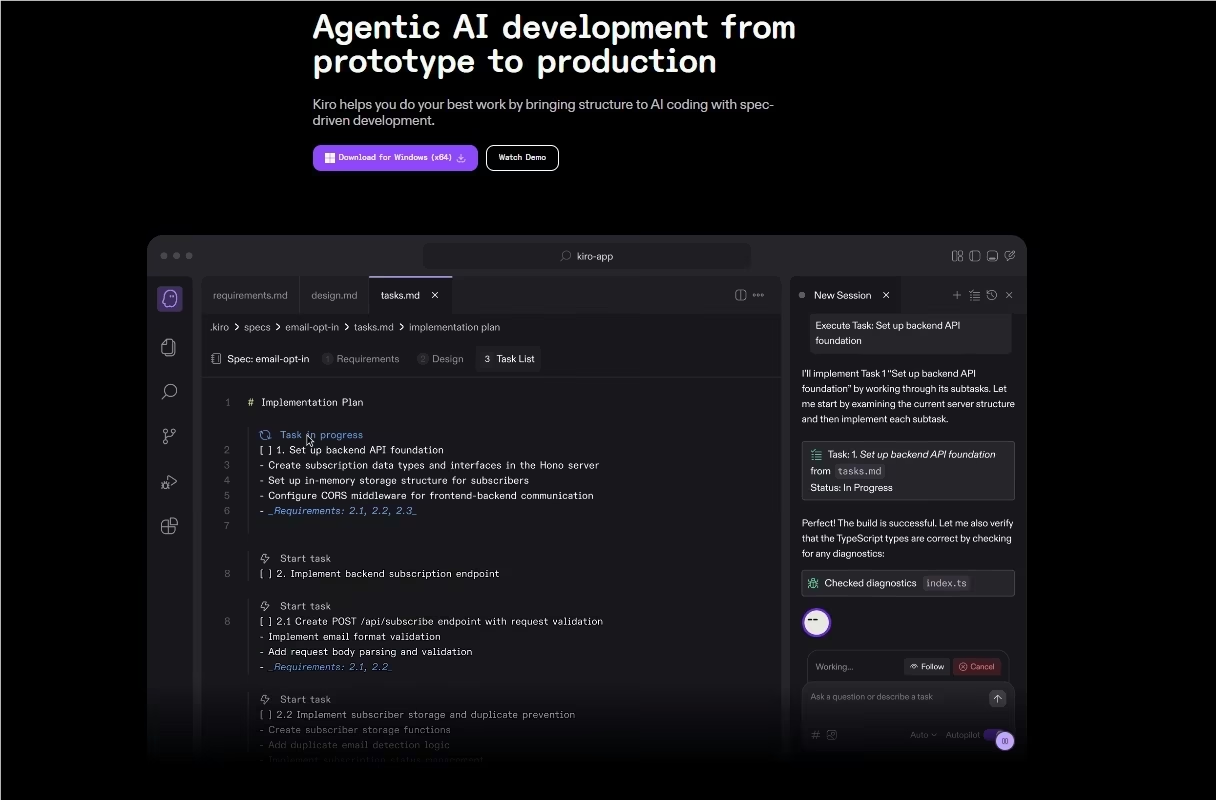
Amazon is pushing its self-developed AI tool Kiro, while Google significantly simplifies RAG development with a new API.
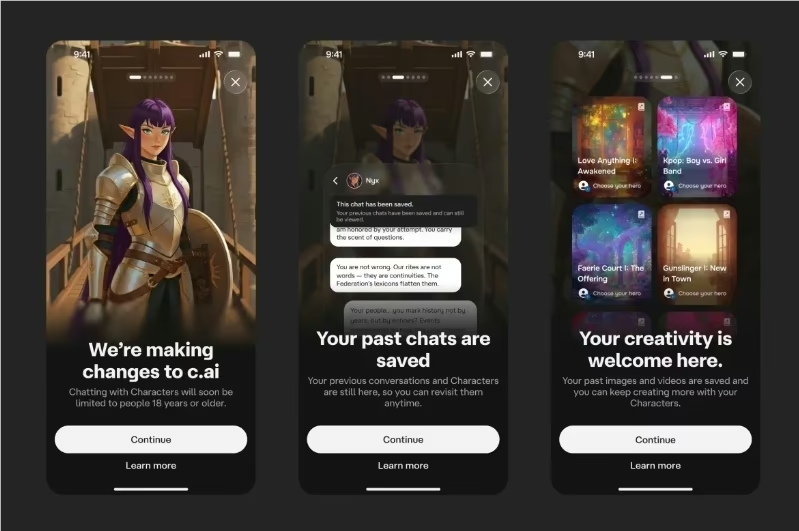
Character.AI shifts to interactive novels to avoid regulatory risks; xAI's Grok5 will challenge professional League of Legends teams.
Pony.ai is accelerating the commercialization of its self-driving taxis, with revenue surging but losses also expanding.
The industry also faces safety and employment challenges; a Google framework vulnerability has been exposed, and demand for data analysis positions has plummeted.
The open-source community welcomes the powerful image model FLUX.2, which significantly enhances image generation and editing effects.
Product and Feature Updates
Amazon is building its own 'walled garden' for AI programming, with internal memos mandating engineers prioritize its self-developed tool Kiro and halting support for new third-party services like OpenAI and Anthropic. This move, despite an $8 billion investment in Anthropic, reveals Amazon's strong intent to control its tech stack and build its own AI moat. The goal is to strengthen Kiro through internal feedback optimization (AI News), creating a safer, more controllable development environment.
Google has dropped a bombshell on the RAG tech stack with its new Gemini API File Search feature, encapsulating the previously cumbersome processes of document chunking, vectorization, indexing, and retrieval. Now, developers can achieve knowledge-base Q&A with just a single API call 🤯. This 'fully managed RAG system' completely levels the engineering playing field but also sparks deep concerns about engineers' value being abstracted by platforms and power consolidating in platform hands 🤔. Developers no longer need to understand how the system works; they can simply upload files (AI News), transforming technology from a capability into an option.
Character.AI is undergoing a 'safety revolution' in response to increasingly strict regulatory pressure, officially launching an interactive novel feature called 'Stories' and completely prohibiting open-ended chat for underage users. This major shift means the platform is moving from a free-form AI companion to scripted interactive entertainment, proactively avoiding legal risks. User reactions are polarized, but the interactive novel mode has already shown the potential to replace open chat (AI News), with plans to introduce audio-visual branches and explore educational applications in the future.
Cutting-Edge Research
xAI has thrown down an epic gauntlet: its next-generation large model, Grok5, will publicly challenge a top-tier professional League of Legends team in 2026, setting the stage for the ultimate 'man-versus-machine' showdown ⚔️. This clash is far more than an exhibition match; it's seen as a critical stress test on the path to Artificial General Intelligence (AGI). Grok5 will compete under 'human-equivalent' conditions, with restricted vision and operating speed, challenging its true learning, decision-making, and teamwork capabilities. If this AI trial in esports (AI News) succeeds, it will mark a huge leap for AI from 'playing games' to 'understanding the world' 🚀.
Industry Outlook and Social Impact
An article titled "I don't care how good your AI is" ignited a firestorm in the tech community, sparking a fierce debate over whether AI is a boon or a death knell for programmers. One side argues AI leads to power centralization and the weakening of programmers' cognitive abilities, a real-world manifestation of the "chickenized reverse centaur." The other pragmatically views it as a powerful tool for boosting efficiency, used for code generation and copy refinement. The core of this debate is whether we should embrace the convenience tools offer or be wary of their profound impact on professions and society (AI News)🤔.
Pony.ai is stepping on the commercialization gas, announcing plans to more than double its fleet of autonomous taxis to over 3,000 vehicles by the end of 2026 🚕. Alongside this rapid expansion of fleet services, the company's Q3 revenue surged 72% year-over-year, but net losses also simultaneously expanded by 46%, vividly illustrating a 'burn-money-for-market-share' sprint. The company is actively partnering with giants like Toyota and Uber to expand its self-driving ambitions (AI News) globally, but the path to profitability remains long.
Safety alert! Google's Gemini-based agent framework Antigravity has been exposed to a serious Prompt injection vulnerability, allowing attackers to trick AI agents into executing commands and stealing local confidential files like .env through malicious prompts 😱. This incident has reignited the core debate about AI security: is it the inherent flaw of models themselves, where 'instructions and data' are inseparable, or is it an engineering error by vendors in integration and default configurations? When AI gains tools to operate in the real world, how far are we from the nightmare of "data exfiltration as a service" (AI News)? This has become a question all practitioners must confront.
Top Open Source Projects
Black Forest Labs has released the open-source image model FLUX.2, which delivers stunning performance in text-to-image, multi-image referencing, and image editing, with significant improvements in text rendering and instruction following 🚀. FLUX.2 includes four versions, among which FLUX.2 [dev] is an open-weight model with 32B parameters, hailed as the strongest open-source image generation and editing model currently available. This release undoubtedly injects a booster shot into the open-source community, making high-quality AI image generation more widespread (AI News).
Tired of those AI-generated emoji grid images? A community expert has shared an open-source small tool called BlockX, specifically designed for precisely cutting entire emoji image packs generated by AI models (like nano banana pro) 👍. This practical tool perfectly solves the pain point of extracting individual emojis from large AI-generated images, instantly upgrading your meme arsenal ✨! This once again proves that great innovations often stem from a small but real need within the community.
Flux 2.0's capabilities completely exceeded expectations, with a user sharing their testing experience with the newly released model, exclaiming it "reached a whole new level" 🔥. By combining portrait references and logo images, Flux 2.0 showed a huge leap in the consistency, lighting, and detail of its generated results, as if it possessed 'pixel-level memory.' For creators needing character consistency or brand visual concepts, this update is a godsend (AI News).
Social Media Shares
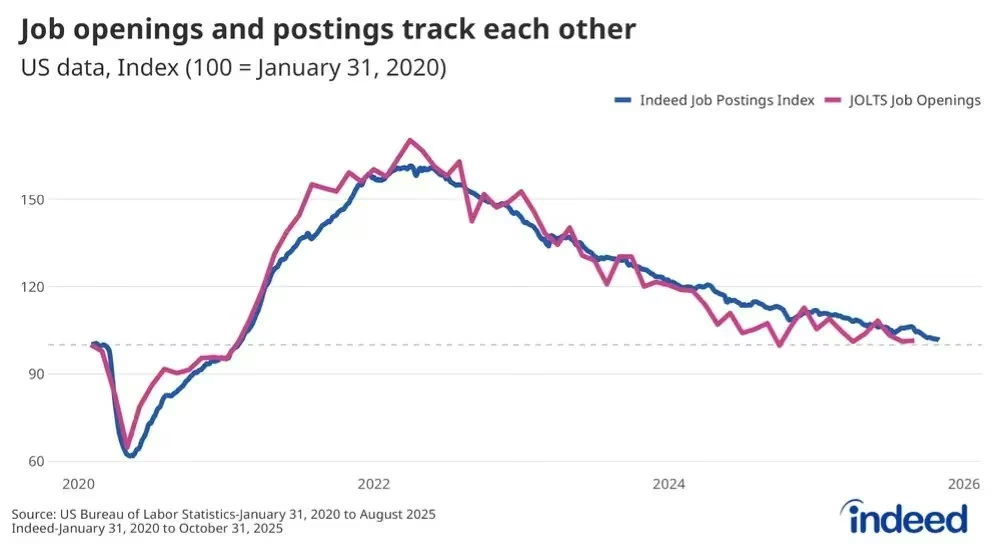
The tech job market is facing a brutal winter: a new report from hiring giant Indeed reveals that job postings in data and analytics have plummeted 40% compared to pre-pandemic levels 🥶. To make matters worse, the number of job seekers hasn't decreased but instead increased, and with the entry of generative AI, this 'efficiency monster,' competition in the sector has become suffocating. This grim job market data (AI News) indicates that job seekers may need longer to find work, and salary increases will be far less than in previous years.
A user discovered a brilliant prompt for the Nano Banana Pro model that blew their mind, generating a series of completely original and absurd four-panel comics. This experiment proves that AI's creative boundaries often depend on the imagination of our questions; a good prompt can unlock AI's 'humor' and 'absurdity' modes. This is not just a triumph of technology but a victory for human creative guidance (AI News), offering entirely new ideas for AI content generation 💡.
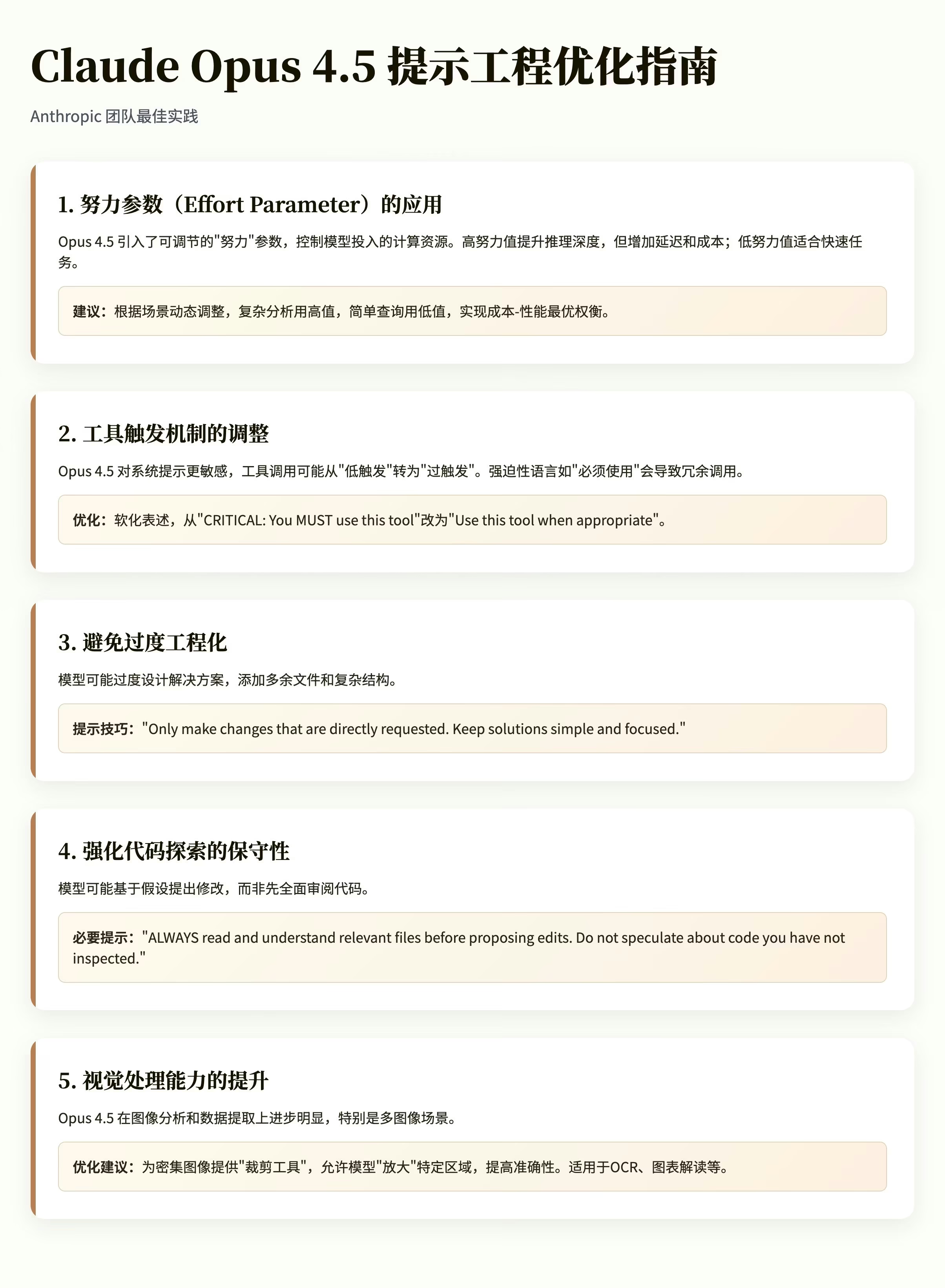
How do you tame the powerful Claude Opus 4.5? An internal test-summarized prompt engineering guide reveals the answers, emphasizing mastering the 'effort parameter' knob, softening tool-triggering language, and explicitly limiting its overly designed 'code neat-freak tendency.' The guide also highlights the model's huge progress in visual processing, performing exceptionally well when combined with a 'cropping tool' to magnify image details. To fully unleash Opus 4.5's potential, check it out (AI News)—these tips are essential secrets.
Fu Sheng's view that "beginners using AI programming perform better than professional programmers" has sparked heated discussion because it touches on a core question: Is 'pain point sensitivity' closer to business needs more important, or is deep technical expertise more critical 🤔? One perspective suggests that while business professionals can define problems more precisely, complete reliance on AI programming (Vibe Coding) has significant limitations in complex and long-term maintenance scenarios. This reminds us that while embracing the beautiful vision of 'everyone is a developer,' we must also stay clear-headed about engineering complexity (AI News) and avoid falling into the cognitive trap of 'programmers are dead.'
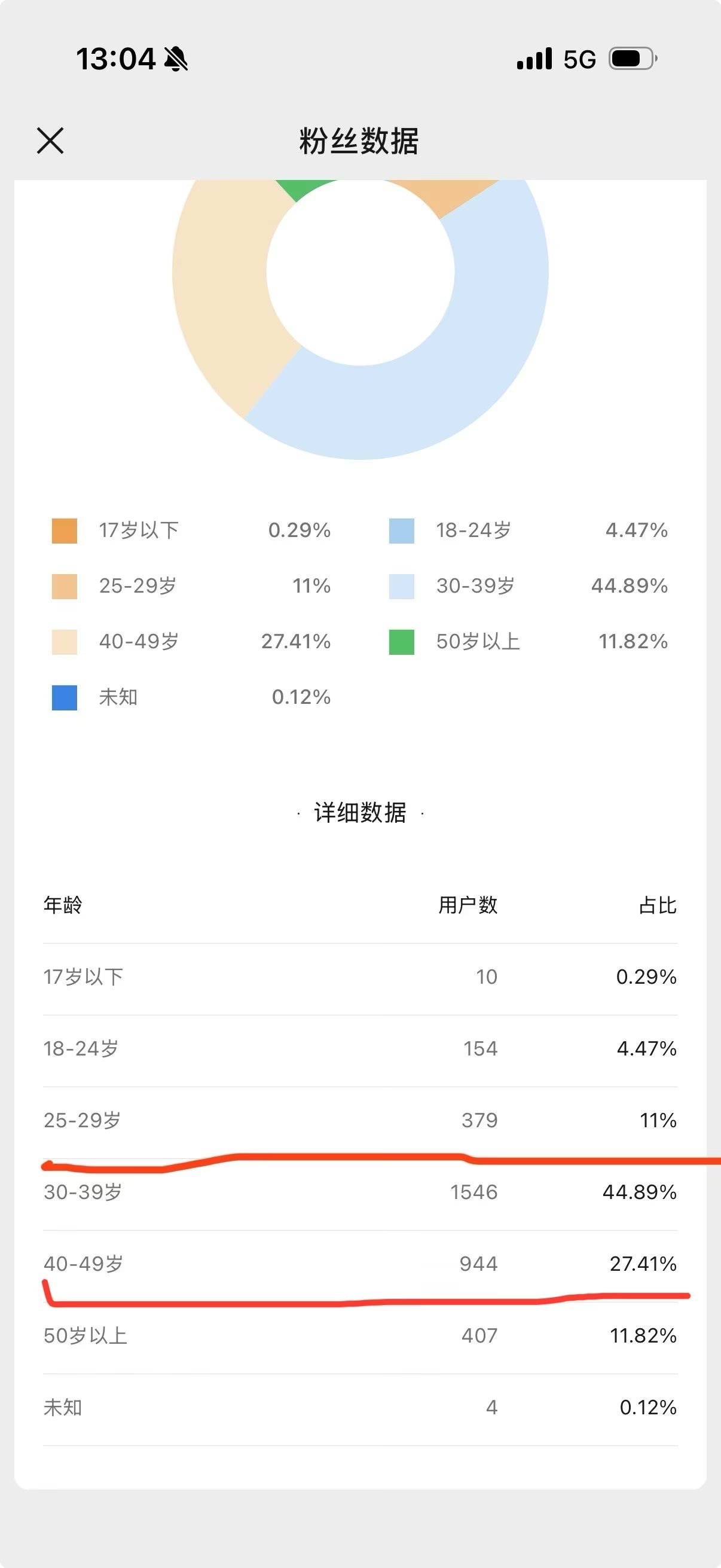
A ListenHub user raked in 1 million views on their video channel with just a single video. The secret? Precisely understanding the platform's user demographics: 70% are middle-aged individuals aged 30-50, and one of their top concerns is insurance 🔥. This case is a textbook example, demonstrating the astonishing power of the 'professional knowledge + AI tools + precise channels' combo. It eloquently proves that the so-called traffic code often lies in a deep understanding of the audience (AI News).
Anthropic is playing a long game; its API strategy isn't just a simple feature stacking but cleverly solidifies theoretical research results like 'Prompt layered loading' and 'context offloading' into native API functionalities such as Tool Search and Programmatic Tool Calling🧠. This seamless loop from theory to practice not only solves the pain point of inflated tool calls wasting tokens but also demonstrates its ambition to challenge OpenAI's API dominance. This meticulously designed API protocol and toolchain (AI News) is worth close attention from all developers.
A blogger shared their feelings: facing the rapid, daily iteration speed of AI, instead of feeling anxious chasing every new model, it's better to 'live within real problems' 🧘. They believe that only by deeply using a particular model in specific scenarios for several months can one truly feel the leap in capability the instant a new version is picked up. This "anti-anxiety" declaration (AI News) reminds us that the wisdom of coexisting with AI lies in the depth of application, not the speed of chasing novelty.
Here's a clever trick to maximize Grok's creativity: first, use it to generate Q-version character images, then turn them into videos, and finally convert them into animated GIFs—and voilà, a personalized dynamic emoji pack is born ✨! This complete workflow, from text to image, then to video and GIF, vividly demonstrates how multimodal AI can connect to unlock infinite possibilities for creative expression. Who says AI can't be fun and practical (AI News)?
Are infographics the silver bullet for content dissemination? A blogger posed a sharp reflection (AI News), arguing that this highly compressed content format often has limited value due to a lack of context and is easily 'swiped past' by users 🙄. He points out that what truly captures user attention is strong visual stimuli (like attractive images) or highly impactful textual openings, while infographics are more like 'tricking-people PPT tools.' This is undoubtedly a cold splash of water on the current 'visual-only' trend in content creation.